In a chilling revelation, a former Iranian political prisoner narrated the cold-blooded words whispered to him by a prison guard: “You believe these sentences from the Judiciary hold weight? We don’t concern ourselves with judgments and court rulings.
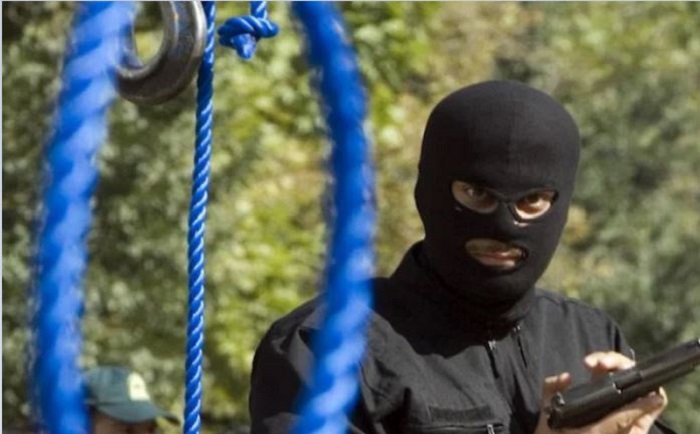
We take lives when we choose.” This harrowing testimony, from a prisoner confined for 12 years in some of Iran’s most notorious prisons, provides a damning insight into a regime that has one of the highest state-sanctioned execution records worldwide, overshadowed only by China.
Furthermore, Amnesty International disclosed that at least 40 of these victims were women. The actual count, however, might be significantly higher since the regime is notorious for its lack of transparency.
Historically, the regime has leveraged public executions as a strategic deterrent against nationwide dissidence, signaling the severe consequences of challenging the status quo. This macabre strategy has been particularly crucial as the nation has been grappling with a cocktail of economic misconduct, discrimination, and systemic oppression.
You, #Iran’s valiant youths, have found the secret to victory and freedom, which is the expansion and continuation of the protests. No power can prevent the continuation of your uprising. Flogging, torture, & execution cannot counter your power of hope and faith.#IranRevolution pic.twitter.com/VhStC6bG3R
— Maryam Rajavi (@Maryam_Rajavi) December 28, 2022
Adding to the milieu of woes is the endemic drug problem afflicting the country. With Iran’s critical position as a transit route for narcotics originating from Afghanistan and Pakistan, the regime has profited immensely from this illicit trade, further weakening its already sanctioned economy.
The Islamic Revolutionary Guard Corps, and its affiliated militias, reportedly play a pivotal role in this dark enterprise. The irony is stark: while narcotics are increasingly accessible to the populace, those caught in drug trade often face death, based on the regime’s whims.
The drug crisis and the soaring execution rate reached a boiling point during the 2022 nationwide uprising. While the regime momentarily halted its executions amidst the tumult, the lull was fleeting. The grim machinery roared back to life, evident from a report by the Kurdistan Democratic Party of Iran highlighting the regime’s relentless execution spree in 2022 and early 2023.
Human rights organizations like Amnesty International have been at the forefront, documenting the oppressive regime’s countless victims. These grim tales of the regime’s vendetta against its populace are a clarion call for the international community.
We support the abolition of death penalty & all cruel punishments in future Iran and are committed to it #iranelection #freeIran
— Maryam Rajavi (@Maryam_Rajavi) October 10, 2009
The regime’s brutality, while manifesting its stronghold, is also revealing cracks within its foundation. Sanctions and international campaigns are casting shadows of doubt within its ranks. If the global community genuinely cherishes values of freedom, expression, and human dignity, it must unequivocally demand that Iran abolish its relentless and brutal death penalty as a precondition for any diplomatic or economic engagement.

MEK Iran (follow us on Twitter and Facebook), Maryam Rajavi’s on her site, Twitter & Facebook, NCRI (Twitter & Facebook), and People’s Mojahedin Organization of Iran – MEK IRAN – YouTu