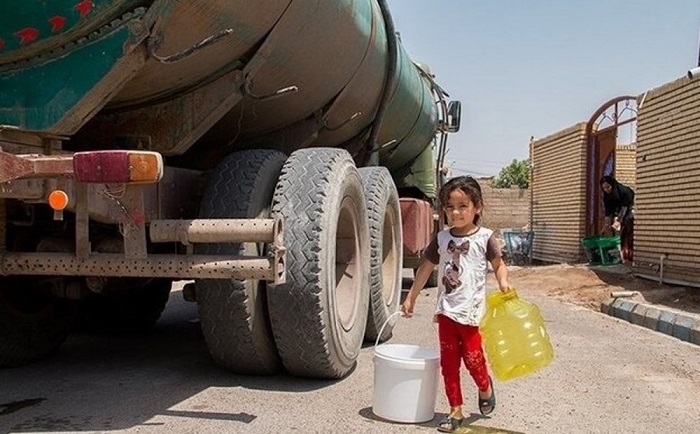
This crisis comes despite earlier assurances from government officials that this year’s rainfall would improve water availability. Hesam Khosravi, Deputy Director of Operations and Water Development at the Tehran Province Water and Wastewater Company, attributed the current disruptions to an unexpected heatwave. He explained that the water supply systems in Tehran were calibrated for cooler conditions and minimal surface water extraction, which has exacerbated the situation.
On Tuesday, June 4, state-run Tejarat News reported that water had been cut off in many parts of Tehran province, including Shahriar County, for over 24 hours without official explanation. This issue is not confined to Tehran; other provinces also report water outages. For instance, Aftab News reported significant water pressure drops and outages in various areas of Isfahan, leaving residents concerned amid the intense June heat. The state-run IRIB also reported water cuts in Najafabad, Isfahan Province.
An in-Depth Look at Iran’s Water Crisis and Its Cause#Iran #water #environmenthttps://t.co/8zuQXxJ3PD
— NCRI-FAC (@iran_policy) June 8, 2021
These water shortages are part of a broader trend of inadequate water management in Iran, leading to widespread social unrest. Mismanagement and outdated agricultural practices contribute significantly to the crisis. Despite adequate rainfall and natural water flows, poor water management has resulted in significant shortages. More than 80% of water resources consumed in the agricultural sector are lost, amounting to between 54 and 55 billion cubic meters per year.
The construction of unscientific dams by the Revolutionary Guards (IRGC) and its front companies has compounded the problem. Before the 1979 revolution, Iran had only 30 dams. Today, according to regime statistics, there are more than 1,330 dams at various stages of operation, implementation, and study. Additionally, the number of deep wells has skyrocketed from 36,000 before the revolution to at least 794,000 by 2015, according to official reports.
July 2021-Thursday marked the 8th consecutive day of protests in Khuzestan province over water shortages and the Iranian regime’s destructive policies.#Iran #IranProtests pic.twitter.com/wUEBhad5P8
— NCRI-FAC (@iran_policy) July 22, 2021
The water crisis in Iran affects many aspects of daily life, including food production, power generation, manufacturing, and sanitation. The situation is particularly dire in urban areas; the Deputy Minister of Energy for Water and Water Supply and Wastewater Affairs reported that 300 out of 1,400 cities in Iran are currently experiencing water stress. Moreover, the CEO of Iran Water and Wastewater highlighted that 272 cities face similar issues, and 10,000 villages rely on portable water supply tanks.
As Iran continues to struggle with water shortages, the need for comprehensive and effective water management strategies becomes increasingly critical. The failure to address these issues adequately has led to significant social unrest, a situation likely to worsen if the crisis persists.

MEK Iran (follow us on Twitter and Facebook), Maryam Rajavi’s on her site, Twitter & Facebook, NCRI (Twitter & Facebook), and People’s Mojahedin Organization of Iran – MEK IRAN – YouTu