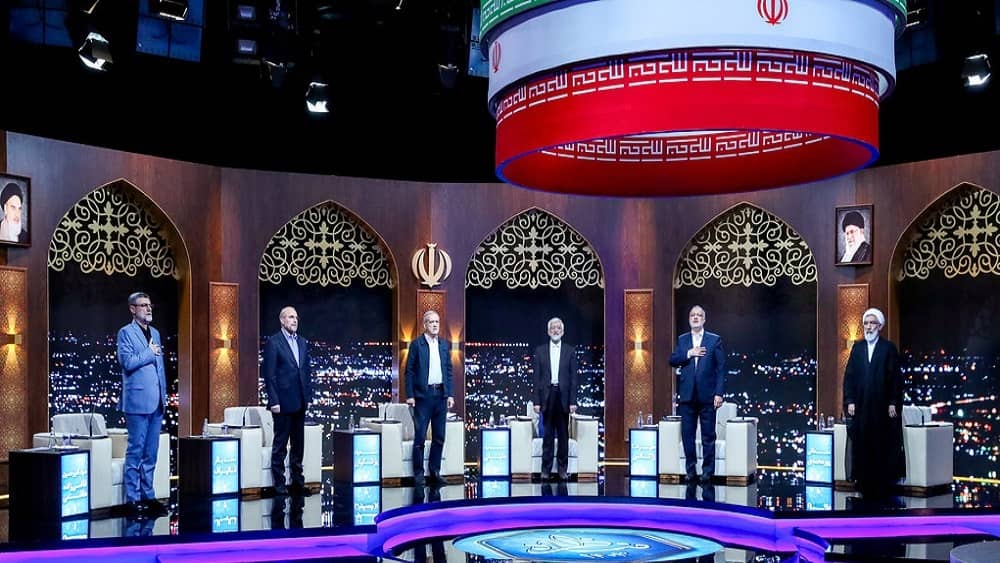
In the lead-up to Iran’s presidential election, the first televised debate among the regime’s loyalist candidates has been widely criticized, with state media branding it a “non-debate.”
Despite warnings from Supreme Leader Ali Khamenei and other high-ranking officials, the event failed to inspire voter confidence, instead exacerbating public disillusionment with the political process.
The Farhikhtegan newspaper, associated with Khamenei’s advisor Ali-Akbar Velayati, summed up the public sentiment with its headline “Non-debate!” The paper criticized the repetitive and uninspired discussions, suggesting they would not boost voter turnout. It further questioned the Guardian Council’s criteria for approving candidates, highlighting the poor performance of some participants.
Media linked to the Revolutionary Guards echoed this sentiment, predicting that the debate’s lackluster nature would deter viewers from future debates. The state-run Mostaqel Online noted that the discussion had only discouraged undecided voters from participating in the election.
#Iranian Election Candidates Vie for Supreme Leader’s Favor, Not Public Approvalhttps://t.co/CjldnfVFOC
— NCRI-FAC (@iran_policy) June 13, 2024
Sazandegi newspaper also criticized the format, accusing the moderators of bias towards Ebrahim Raisi, the current judiciary chief and a frontrunner in the election. The paper pointed out that lengthy speeches by the moderators overshadowed the main event, reducing its impact.
To control the narrative, Khamenei’s office issued a statement warning against misquoting the Leader of the Revolution or his office officials. This move aimed to maintain the regime’s grip on the election discourse amid rising public frustration.
Kayhan newspaper cautioned Principlist candidates against dividing their voter base, referencing the 2013 election when internal conflicts cost the faction dearly. Meanwhile, former President Hassan Rouhani requested a chance to respond to accusations made during the debate, emphasizing the contentious atmosphere.
State Officials in #Iran Criticize Election Engineering, Experts Warn Khameneihttps://t.co/cBq5eIzvhq
— NCRI-FAC (@iran_policy) June 11, 2024
Despite the controlled and orchestrated nature of the debate, some candidates openly admitted to the regime’s policy failures. Amir Masoud Qazizadeh Hashemi lamented unfulfilled promises that led to public disillusionment. Alireza Zakani highlighted the economic disparity between earnings in rials and expenditures pegged to dollar rates. Mostafa Pourmohammadi acknowledged the detrimental impact of sanctions and the government’s failure to address them adequately.
Mohammad Bagher Ghalibaf criticized resource wastage, while Masoud Pezeshkian pointed out the continuous decline in the value of money and purchasing power, blaming poor fiscal management. Saeed Jalili cited the drastic reduction in industrial production due to mismanagement, and Zakani called out the internal incompetence of those in power.
#Iran’s Regime Prepares to Rig Presidential #Election Results in Crisis Management Strategyhttps://t.co/RPzVhxEd5b
— NCRI-FAC (@iran_policy) June 16, 2024
The debate has thus far deepened public skepticism and highlighted the regime’s internal conflicts, with candidates turning against each other and acknowledging systemic issues. As the election approaches, the Iranian public remains wary, questioning the authenticity of the electoral process and the regime’s ability to address their concerns effectively.

MEK Iran (follow us on Twitter and Facebook), Maryam Rajavi’s on her site, Twitter & Facebook, NCRI (Twitter & Facebook), and People’s Mojahedin Organization of Iran – MEK IRAN – YouTu