Freeh highlighted the importance of accountability, specifically the need to prosecute war criminals responsible for heinous acts under the current regime.
Director Freeh praised the perseverance and bravery of Maryam Rajavi and the Iranian Resistance, expressing confidence that their efforts would soon lead to significant change. He recounted the numerous challenges faced in holding the Iranian regime accountable for its actions, referencing the Khobar Towers bombing in 1996, which resulted in the death of 19 Americans and was orchestrated by the IRGC and Hezbollah.
Freeh criticized the longstanding policy of appeasement towards Iran, pointing out the failure to make serious attempts to bring perpetrators to justice. He called for immediate action to document and archive evidence, ensuring that prosecutors will have the necessary resources to hold the regime’s criminals accountable once it falls.
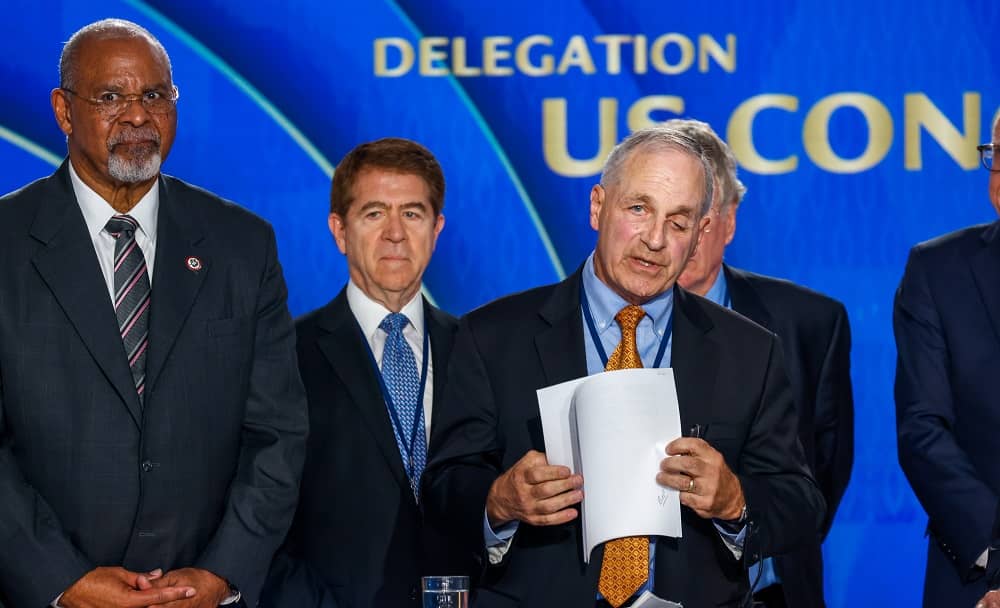
There is a strong, bipartisan delegation of U.S. officials led by former FBI Director Louis Freeh and U.S. Attorney General Michael Mukasey attending the 2024 Free Iran World Summit. I am proud to support the democratic aspirations of the Iranian people. 🇺🇸 pic.twitter.com/c0aNVutNgm
— Ivan Sascha Sheehan, Ph.D. (@ProfSheehan) June 29, 2024
Emphasizing the broad jurisdiction of U.S. terrorism laws, Freeh urged the international community to begin planning for the accountability process now. He stressed the importance of justice for the victims and their families and the necessity of rebuilding Iran on a foundation of accountability and the rule of law.
In his speech, Freeh highlighted two main points: the struggle for freedom led by the Iranian people and the leadership of Maryam Rajavi, and the critical need for accountability post-regime collapse. He expressed his belief that the regime is on the brink of collapse, either gradually or suddenly, as indicated by recent developments.
Freeh dismissed the idea of a truth and reconciliation commission for the regime’s war crimes, advocating instead for prosecutions and trials. He called for the establishment of trial courts with jurisdiction and the capability to sentence and punish those convicted.
Reflecting on past U.S. policy towards Iran, Freeh lamented the years of appeasement that have allowed the regime to evade accountability. He shared an anecdote from his time in office in 1993 when efforts to investigate Iranian activities in the U.S. were met with resistance from the State Department. He also recounted the Khobar Towers bombing and the subsequent difficulties in bringing those responsible to justice.
3-Louis Freeh:
"End 30 years of US appeasement towards Iran's regime."#MaryamRajavi4FreeIran #FreeIran2024 #FreeIran10PoinPIan pic.twitter.com/QpyviYht1Q— Iran Freedom (@4FreedominIran) July 5, 2024
Despite efforts to seek accountability, Freeh noted that no U.S. administration since 1996 has made a concerted effort to extradite the 14 individuals indicted for the Khobar Towers bombing. He criticized the failure to include accountability measures in negotiations with Iran, even when providing financial relief and lifting sanctions.
Freeh concluded by emphasizing the need to plan now for the prosecution of thousands of war criminals once the Iranian regime collapses. He called for the documentation and archiving of evidence, and the preparation of case files to ensure that justice can be served swiftly. He stressed the broad jurisdiction of U.S. terrorism laws, which allow for the prosecution of individuals with minimal contact with the U.S., often through financial transactions.
By preparing for accountability now, Freeh argued, the international community can ensure that there will be a significant debt paid to the victims and their families once a new government takes over in Iran.

MEK Iran (follow us on Twitter and Facebook), Maryam Rajavi’s on her site, Twitter & Facebook, NCRI (Twitter & Facebook), and People’s Mojahedin Organization of Iran – MEK IRAN – YouTu