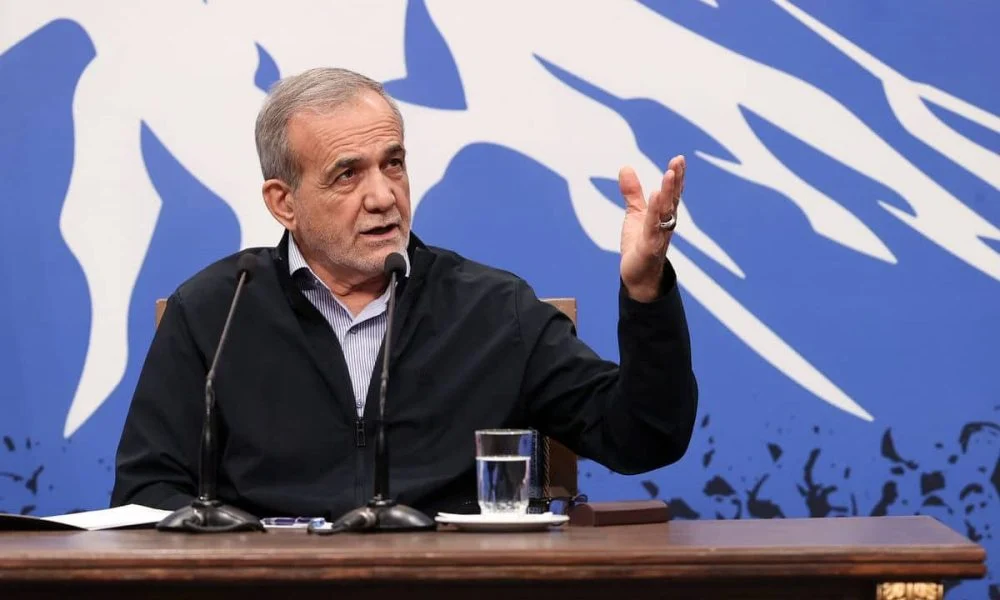
During his first public address, Pezeshkian attempted to project a revised image of the regime, blaming the United States for Tehran’s global isolation. However, his comments were met with sharp criticism from rival factions, reflecting the increasing fractures within the leadership.
Pezeshkian’s rhetoric largely focused on shifting the blame for international sanctions and isolation onto the U.S., stating that America must “prove it isn’t hostile towards us.” He conveniently downplayed the regime’s long history of regional aggression, support for terrorism, and pursuit of weapons of mass destruction. His call for “brotherhood” with the American people was widely perceived as a thinly veiled plea for the lifting of sanctions, without addressing the fundamental issues that have caused Iran’s pariah status.
Power Struggle Intensifies in #Iran as Rival Factions Slam #Pezeshkian’s Governmenthttps://t.co/j6FF8DT5LL
— NCRI-FAC (@iran_policy) September 12, 2024
This approach triggered an immediate backlash from hardliners within the regime. Amir Hossein Sabeti, a prominent parliamentarian, criticized Pezeshkian for straying from Iran’s constitutional mandate to export the revolution. Sabeti publicly challenged the president’s stance, emphasizing that Articles 152 and 154 explicitly call for the propagation of the Islamic Revolution abroad, questioning if the president intended to honor the constitution.
Criticism also emerged from Iran’s conservative media outlets. Vatan-e Emrooz lambasted Pezeshkian’s foreign policy as “immature,” particularly taking issue with his comments regarding Yemen’s missile strikes, which were seen as an indicator of his lack of understanding of the region’s complexities.
Infighting Intensifies as Pezeshkian Laments Factional Obstruction in #Iran’s Regimehttps://t.co/vmcyGwu7uW pic.twitter.com/q3RWpmTz8q
— NCRI-FAC (@iran_policy) August 10, 2024
Similarly, Raja News, aligned with the hardliner Saeed Jalili faction, described Pezeshkian’s performance as “weak” and accused his media team of orchestrating a manipulated press conference by selecting only friendly journalists.
The infighting further intensified with accusations of nepotism and controversial appointments. Several former officials from President Ebrahim Raisi’s administration have been quietly reassigned to influential roles within Pezeshkian’s government. The return of former Foreign Minister Mohammad-Javad Zarif, despite his resignation due to his child’s foreign citizenship, has also sparked outrage among regime critics.
Amid Escalating Domestic Crises in #Iran, Rival Factions Target #Pezeshkian’s Governmenthttps://t.co/klEZH4CR9Z
— NCRI-FAC (@iran_policy) September 1, 2024
As Pezeshkian grapples with internal discord, his failure to unite the various factions within Iran’s leadership is further exacerbating the regime’s instability. Amid mounting pressure from both domestic unrest and international isolation, the growing divisions within the regime are undermining its efforts to present a unified front at a critical juncture in Iran’s political landscape.