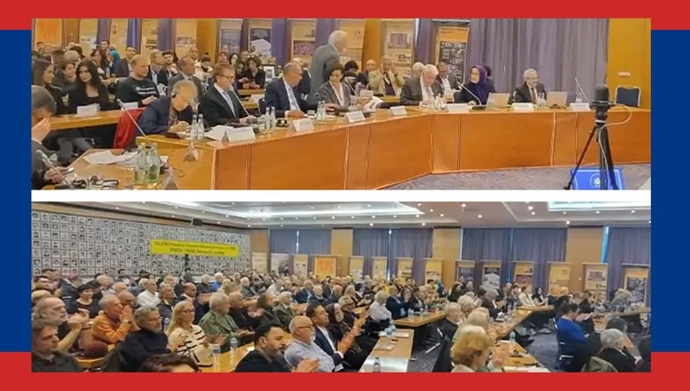
Among the attendees were prominent political figures such as Maryam Rajavi, head of the National Council of Resistance of Iran (NCRI), former European Parliament Vice President Professor Alejo Vidal-Quadras, and former German Defense Minister Dr. Franz Josef Jung. The event spotlighted the challenges posed by what was described as the “religious fascism” of Iran’s government, with attendees advocating for a complete overhaul in how the West approaches Tehran.
A recurring theme throughout the conference was the failure of longstanding Western policies of appeasement toward Iran, which, according to speakers, has done little to curb the regime’s destabilizing activities. Instead, it has inadvertently emboldened Iran’s Revolutionary Guard Corps (IRGC) and extended Tehran’s influence across the Middle East.
Professor Vidal-Quadras underscored the need for the European Union to label the IRGC as a terrorist organization, a move he believes would curb Iran’s operational reach. This designation, already adopted by the United States and Canada, is seen as a necessary step to counterbalance what Vidal-Quadras referred to as the IRGC’s destabilizing influence.
— Alejo Vidal-Quadras (@VidalQuadras) October 26, 2024
Former U.S. diplomat Ambassador Lincoln Bloomfield Jr. also voiced strong criticism of the current approach. Bloomfield emphasized that the West has long held a misguided belief in the regime’s potential for reform. He argued that years of misinformation and alleged “agents of influence” acting on behalf of Tehran have skewed policymakers’ perspectives, shielding the regime from accountability. Bloomfield urged a reassessment of this stance, calling for Western governments to recognize the existence of an organized, democratic opposition.
Other speakers echoed the call for a stronger stance, particularly in regard to human rights. Dr. Herta Däubler-Gmelin, a former German Justice Minister, pointed out that repression within Iran not only harms the Iranian people but also threatens peace in the wider region. “Freedom in Iran guarantees peace in the Middle East,” she declared, urging Germany and the EU to take action against Iran’s human rights abuses.
Central to the discussions was the role of the NCRI as a viable opposition to Iran’s ruling theocracy. Leo Dautzenberg, Head of the German Committee for Solidarity with a Free Iran, criticized the West’s missed opportunities, particularly in 1979, to support true democratic movements within Iran. He advocated for the West to adopt a firm policy shift: severing ties with Iran’s current leadership while supporting NCRI’s democratic efforts.
As tensions remain high, advocates for change contend that a new, decisive strategy could reshape the landscape, promoting peace and democracy in Iran and the region at large.

MEK Iran (follow us on Twitter and Facebook), Maryam Rajavi’s on her site, Twitter & Facebook, NCRI (Twitter & Facebook), and People’s Mojahedin Organization of Iran – MEK IRAN – YouTu