The demonstrations, sparked by frustrations over systemic corruption and discriminatory economic policies, shone a spotlight on deepening public discontent under the mullahs’ regime.
In Tehran, retired educators led a vocal protest, demanding long-overdue payment of 60% of their end-of-service benefits. Holding banners that declared, “The teacher is aware and despises discrimination,” they highlighted years of systemic neglect and sought fair treatment in a system rife with inequality.
January 13—Tehran, Iran
Recently retired teachers and educators resume weekly rallies to protest low pensions and unpaid retirement bonuses despite the passage of 16 months.
Protesters chant, "Educators are aware and despise discrimination"#IranProtestshttps://t.co/Jv5IIugMW0— People's Mojahedin Organization of Iran (PMOI/MEK) (@Mojahedineng) January 13, 2025
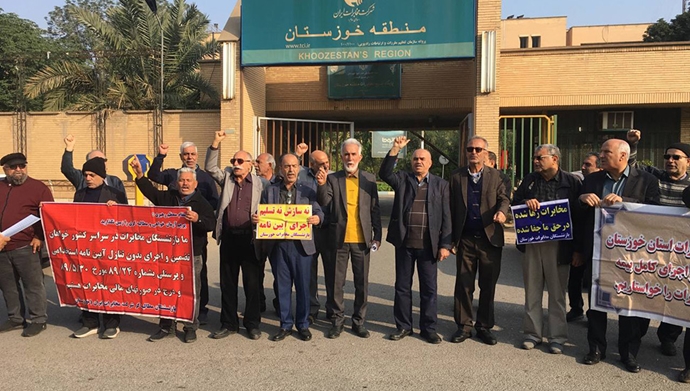
Similar frustrations boiled over in other cities. Retired telecommunications employees in Tehran, Kermanshah, and Ilam condemned the exploitative practices of government-affiliated entities, particularly the Execution of Imam Khomeini’s Order (EIKO) and the IRGC Cooperative Foundation. Protesters decried the misappropriation of their funds and called for transparency in managing their financial entitlements.
Protests also erupted in Ahvaz, Urmia, and Sanandaj, where retirees demanded the enforcement of laws protecting their benefits. The chants, such as “Retirees rise against tyranny and discrimination,” underscored their unified rejection of institutionalized corruption and neglect.
January 13—Ahvaz, southwest Iran
Retirees of the Telecommunication Company of Iran (TCI) resume protest rallies, demanding higher pensions and other basic needs based on the regime's own laws.#IranProtestspic.twitter.com/42Z3aW0zVs— People's Mojahedin Organization of Iran (PMOI/MEK) (@Mojahedineng) January 13, 2025
Cities like Marivan, Bijar, Shiraz, and Isfahan added to the wave of demonstrations. Protesters there condemned the regime’s failure to implement regulations that guarantee their rights, while calling for the restitution of mismanaged or stolen funds. The refrain “EIKO and IRGC have stolen our rights” encapsulated the growing anger against these entities.
January 13—Urmia, northwest Iran
Retirees of the Telecommunication Company of Iran (TCI) resume protest rallies, demanding higher pensions and other basic needs based on the regime's own laws. #IranProtests pic.twitter.com/4KDo7DVHrb— People's Mojahedin Organization of Iran (PMOI/MEK) (@Mojahedineng) January 13, 2025
These protests are emblematic of Iran’s mounting social and economic crises. Retirees and workers, many of whom have dedicated decades to their professions, find themselves grappling with eroded living conditions, inflation, and government inaction. Their demonstrations not only reveal widespread disillusionment but also a call for systemic reforms to bridge the gap between the people and the state.
Observers note that the regime’s reluctance to address these grievances risks escalating tensions further. The protesters’ demands—justice, accountability, and improved livelihoods—reflect the urgent need for change. Ignoring these calls could lead to broader unrest, posing a significant challenge to the regime’s stability.
January 13—Shahrekord, western Iran
Retirees of the Telecommunication Company of Iran (TCI) hold protest rally in front of the TCI headquarters, demanding higher pensions and other basic needs based on the regime's own laws.#IranProtests pic.twitter.com/9XLn1ITsTW— People's Mojahedin Organization of Iran (PMOI/MEK) (@Mojahedineng) January 13, 2025
The January 13 protests mark another chapter in Iran’s ongoing struggle for justice and transparency, highlighting the resilience of its people amid adversity.

MEK Iran (follow us on Twitter and Facebook), Maryam Rajavi’s on her site, Twitter & Facebook, NCRI (Twitter & Facebook), and People’s Mojahedin Organization of Iran – MEK IRAN – YouTu