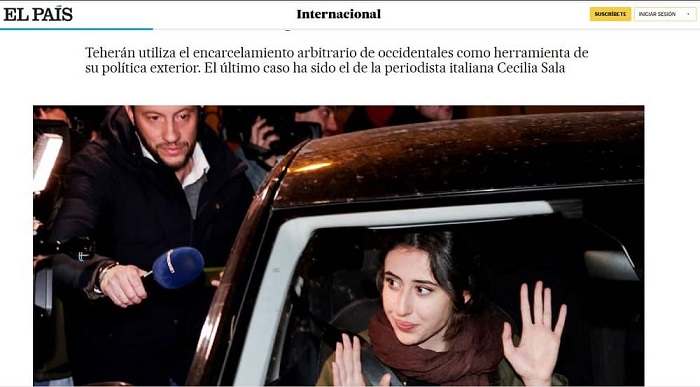
In a move that has rattled European governments, recent developments reveal that Iran is once again deploying hostage diplomacy as a tool to extract political and financial concessions. A detailed report by El País highlights how Tehran is strategically detaining Western citizens, using their plight to drive a wedge among European allies while furthering its foreign policy aims.
The case of Italian journalist Cecilia Sala, who was released after 20 days in detention, stands in stark contrast to the continued imprisonment of several French nationals. Analysts, including Clément Therme from the French Institute of International Relations (IFRI), argue that the selective release was designed to sow discord within Europe.
The timing of Sala’s release—on January 8—coincided closely with Italy’s diplomatic maneuvers; just four days prior, Justice Minister Carlo Nordio had ordered the release of Iranian detainee Mohammad Abedini Najafabadi. Italian Prime Minister Giorgia Meloni’s reported negotiations with former President Donald Trump, which secured U.S. approval to suspend Najafabadi’s extradition to Washington, further underscore the high-stakes chess game being played amid renewed nuclear negotiations in Geneva.
In light of Hamid Noury's release today, it's crucial to revisit the endless cycle of Western appeasement fueling #Iran's regime #terror and hostage-taking. This loop, starting with Iranian dissidents, now ensnares Western officials and citizens.https://t.co/ieaaOkZb6y
— NCRI-FAC (@iran_policy) June 15, 2024
Meanwhile, the situation remains tense for France. Citizens Cécile Kohler, Jacques Paris, and Olivier Grondeau are still held in Iran. French analysts contend that Tehran’s decision to withhold their release is a calculated response to President Emmanuel Macron’s recent discussions regarding the activation of the ‘snapback’ mechanism—a measure that could reimpose sanctions on Iran for nuclear non-compliance. David Rigoulet-Roze, a researcher at the French Institute for International and Strategic Affairs (IRIS), noted that Iran appears to be using these detainees as bargaining chips to dissuade Paris from a tougher stance during the negotiations.
Iran’s historical reliance on hostage exchanges is not new. The regime has previously leveraged the detention of dual-national prisoners to secure financial relief. For instance, after a prisoner swap with the U.S. in 2016, Iran received $1.7 billion in cash transfers—a deal widely criticized as a de facto ransom payment. Similarly, a 2023 prisoner exchange involving Belgium reinforced Tehran’s belief in the effectiveness of this coercive strategy.
The #Iranian regime aired an interview with Asadollah Assadi, its convicted diplomat #terrorist, who was jailed in Belgium for a foiled 2018 bomb plot in Paris. This move seeks to bolster its hostage-taking diplomacy for both domestic and international audiences. pic.twitter.com/SIhC5faqkK
— NCRI-FAC (@iran_policy) August 6, 2024
Amid these unfolding events, European lawmakers have condemned Iran’s tactics. On January 25, the European Parliament passed a resolution urging the immediate release of detained European citizens and calling for expanded sanctions against Iranian officials involved in human rights abuses. As nuclear negotiations reach a critical juncture, European leaders now face mounting pressure to formulate a united response to Tehran’s divisive strategies, raising the pressing question: can Europe overcome internal divisions to effectively counter Iran’s hostage diplomacy?

MEK Iran (follow us on Twitter and Facebook), Maryam Rajavi’s on her site, Twitter & Facebook, NCRI (Twitter & Facebook), and People’s Mojahedin Organization of Iran – MEK IRAN – YouTu