A major land dispute involving the Kayhan Institute, a state-controlled media entity directly overseen by Supreme Leader Ali Khamenei, has sparked renewed concerns over judicial accountability and institutional corruption within Iran’s ruling establishment. Allegations of illegal land acquisition, initially reported by a state-affiliated journalist, have drawn attention to the institute’s decades-long defiance of legal rulings and the broader culture of impunity enjoyed by entities tied to the regime’s leadership.
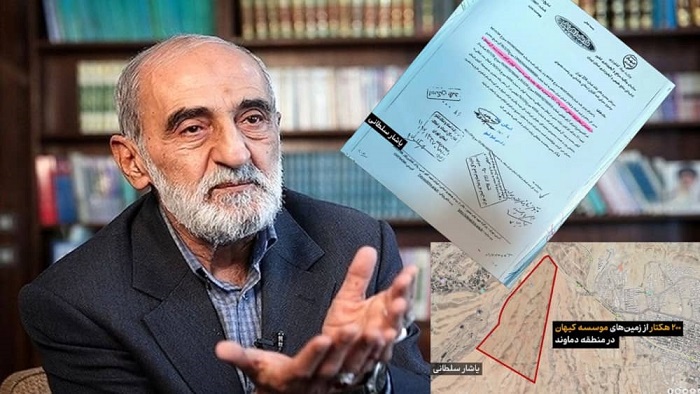
At the core of the controversy is a 200-hectare (2 million square meters) land parcel in Damavand, which the Kayhan Institute has occupied despite a final court ruling in 2006 declaring the ownership transfer illegal. The initial land grant dates back to 1996, when the government of then-President Ali-Akbar Hashemi Rafsanjani approved the transfer under the guise of afforestation and agricultural development. However, records show that no such projects were ever undertaken, and the land instead became a private, restricted estate shielded from oversight.
In 2003, mounting concerns over land misallocation led the Iranian Parliament to amend the Forest and Rangeland Protection Law, revoking unauthorized land transfers that failed to meet developmental goals. This triggered legal reviews, including an investigation into Kayhan’s landholdings. By 2006, a Tehran court ruled unequivocally that the land must revert to public ownership, converting Kayhan’s claim into a lease agreement under state control.
Kazem Sedighi, A Khamenei Ally, Exposed to Have Grabbed Billions Worth of Land in #Iran's Capitalhttps://t.co/CmbzjfHMsP pic.twitter.com/cze9r5g7rI
— NCRI-FAC (@iran_policy) March 18, 2024
Despite the court’s final and non-appealable ruling, the Kayhan Institute has refused to comply, leveraging political influence, administrative loopholes, and bureaucratic stalling tactics to delay enforcement. Even efforts by the Tehran Natural Resources Office to reclaim the land have been obstructed, with a state notary office citing the need for additional judicial enforcement orders—despite the original ruling already holding final legal authority.
This defiance underscores the privileged status of institutions closely linked to the Supreme Leader. Under the leadership of Hossein Shariatmadari, Khamenei’s appointed representative, Kayhan has long positioned itself as a hardline enforcer of the regime’s ideological stance, advocating censorship and aggressive policies. Yet, its refusal to comply with judicial mandates contradicts its own rhetoric of upholding revolutionary values.
The Kayhan scandal is emblematic of a broader pattern of systemic corruption within Iran’s clerical establishment. Similar land-grabbing cases have implicated high-ranking figures, including Tehran’s Friday Prayer Leader Kazem Sedighi, who was recently exposed for amassing billions of tomans in prime real estate under opaque legal arrangements.
While ordinary citizens face severe repercussions for minor infractions, powerful regime-affiliated entities continue to operate above the law, securing public assets with little accountability. The persistence of the Kayhan land dispute raises serious concerns about the rule of law in Iran and whether authorities will ultimately enforce the legal judgment or allow another regime-aligned institution to evade accountability.
#Iran News in Brief
According to local sources, the #IRGC is trying to expand in the Iranian #Kurdistan region by confiscating land and building bases. https://t.co/25WEIRNZrm pic.twitter.com/dW3x918C36
— NCRI-FAC (@iran_policy) May 30, 2022
Notably, despite the sensitivity of the case, reports on Kayhan’s involvement remain accessible online at the time of this writing—an unusual deviation from the regime’s typical suppression of politically charged exposés. This has fueled speculation about internal power struggles or a security-driven agenda aimed at reining in elements within the ruling establishment.

MEK Iran (follow us on Twitter and Facebook), Maryam Rajavi’s on her site, Twitter & Facebook, NCRI (Twitter & Facebook), and People’s Mojahedin Organization of Iran – MEK IRAN – YouTu