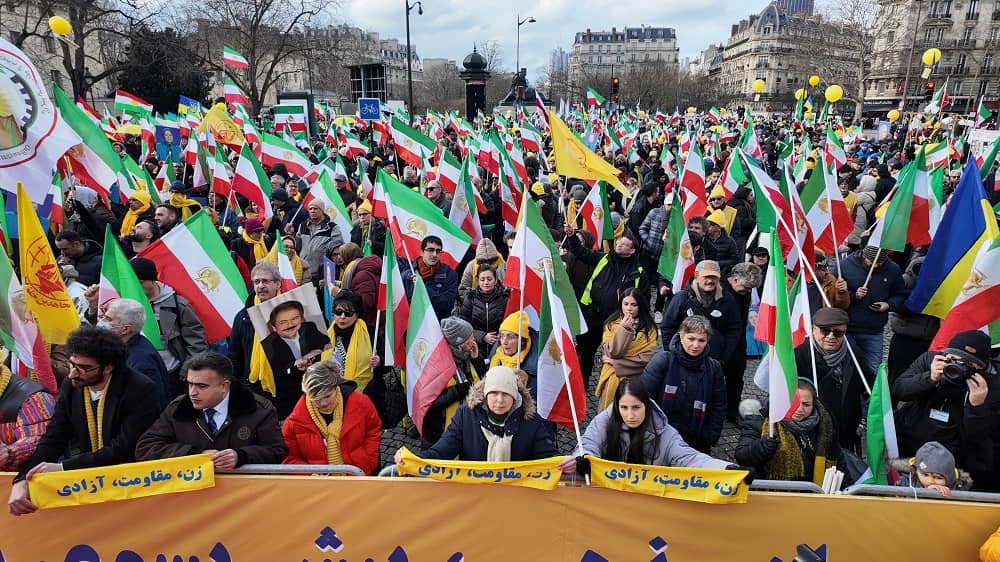
As Iran commemorates another anniversary of the 1979 Revolution, thousands of Iranians gathered in Paris to demand a new future for their homeland. The demonstration, attended by an estimated 20,000 people, showcased the voices of three generations who reject both the monarchy of the Shah and the theocratic rule of the mullahs. Their chants of “No Shah, No Mullah” echoed through the streets, symbolizing their determination to establish a democratic Iran.
The Paris protest was more than a show of dissent; it was a declaration of intent. Demonstrators expressed solidarity with Resistance Units operating inside Iran and pledged their support for the National Council of Resistance of Iran (NCRI). Many carried banners endorsing the Ten-Point Plan of Maryam Rajavi, the NCRI’s president-elect, which outlines a peaceful transition to democracy after the downfall of the current regime.
Iran is currently grappling with a deep crisis. The clerical regime, once sustained by repression and state-controlled propaganda, is experiencing unprecedented levels of instability. Economic collapse, surging inflation, widespread poverty, and an erosion of civil rights have fueled growing public outrage. Mass protests and strikes across the country indicate that Iranian society is teetering on the edge of a major upheaval.
An endless line of demonstrators stretches from Place Denfert-Rochereau to Place Vauban, calling for democracy and rejecting dictatorship. A powerful moment captured in this 30-minute footage. #FreeIran2025 pic.twitter.com/SQqKvglRb2
— SIMAY AZADI TV (@en_simayazadi) February 9, 2025
The government’s response has been one of force, with crackdowns and executions aiming to silence dissent. However, these measures have only intensified public anger, further weakening the regime’s grip on power. Meanwhile, its influence in the Middle East is waning. The loss of key allies, such as the Assad regime in Syria and the declining power of Hezbollah, has diminished Iran’s regional standing. Furthermore, global scrutiny over its nuclear ambitions has left the regime increasingly isolated on the world stage.
Perhaps the greatest challenge facing the Iranian regime is the growing strength of organized resistance movements. The NCRI and the People’s Mojahedin of Iran (PMOI/MEK) have continued their efforts to mobilize opposition both within Iran and internationally. Despite relentless state suppression, public acts of defiance, including strikes and demonstrations, persist, underscoring the population’s determination for change.
With its regional influence diminishing, its economy in freefall, and domestic unrest growing, the Iranian regime finds itself in an increasingly precarious position. The Iranian people, resilient in their struggle, have demonstrated their readiness to seize the moment for democratic transformation.
The generation of the 1979 Revolution was massacred time and again, shackled in chains, and bombarded with lies and demonization. Yet, it endured and multiplied in the rebellious and uprising generations.
They sought to extinguish and bury Iran’s revolution. But under Massoud… pic.twitter.com/g3zuCsXrgL— Maryam Rajavi (@Maryam_Rajavi) February 8, 2025
As Iran’s crisis deepens, the international community faces a critical decision. The era of appeasing the Iranian regime appears to be drawing to a close. More voices are calling for support of the Iranian people’s democratic aspirations rather than continued engagement with the ruling establishment.
The 1979 Revolution was meant to bring freedom and justice, but those ideals were usurped by the clerical regime. Now, over four decades later, a new revolution may be on the horizon—one that aims to fulfill the Iranian people’s long-awaited promise of liberty, justice, and democracy.

MEK Iran (follow us on Twitter and Facebook), Maryam Rajavi’s on her site, Twitter & Facebook, NCRI (Twitter & Facebook), and People’s Mojahedin Organization of Iran – MEK IRAN – YouTu