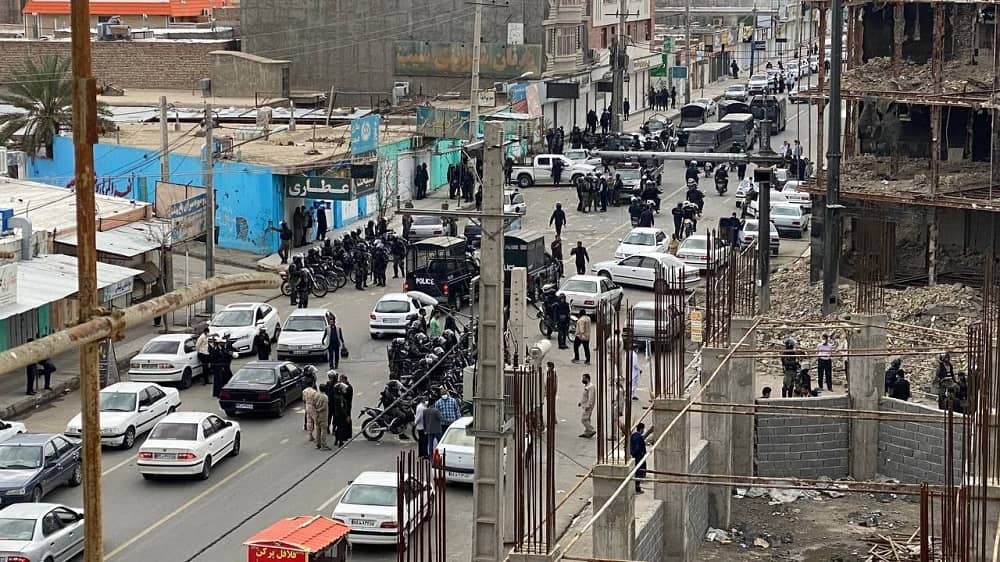
In recent weeks, high-ranking Iranian government officials have publicly revealed their deep-seated fear of possible mass protests. Faced with a population that is increasingly dissatisfied because economic conditions are deteriorating and government systems are failing, those in charge are resorting to familiar strategies: blaming external enemies and contrived conspiracies.
However, this rhetoric reveals above all the great concern of the leadership that the discontent of the population could turn into uprisings. Iran’s Revolutionary Guard Corps (IRGC) recently made a significant statement that clarifies the government’s strategic stance. Mehdi Sayari, the deputy head of IRGC intelligence, said that opponents of the regime “have changed the model of overthrow.
Watch and judge why this terrified military commander serving the terrorist regime in #Iran aims to disarm the explosive society. pic.twitter.com/hk3s2xKFSC
— NCRI-FAC (@iran_policy) October 10, 2023
” He claimed that these opponents were “shaping economic problems in such a way that they spread despair in society.” According to Sayari, these strategies aim to paint the picture of a collapsing Iran on social media in order to increase the hopelessness of the population.
These statements are a clear sign that the Iranian leadership sees the economic crisis as one of the greatest threats. With inflation, high unemployment and a collapsing currency, there is great dissatisfaction among the population. However, the government tries to portray these problems as externally directed attacks in order to conceal its own responsibility for mismanagement and corruption. The fear is clearly palpable: the government fears that the economic emergency could lead to a broad mobilization of the population.
Raisi Government and Parliament Clash Amidst Restive Society and #Economic Turmoil in #Iranhttps://t.co/vPsBKxK4mO
— NCRI-FAC (@iran_policy) April 30, 2024
Everyday problems such as water shortages and power outages are also externalized. Mohammad Mehdi Hosseini Hamedani, a representative of Khamenei in Alborz province, claimed that “the enemy is using water and electricity shortages to turn people against the government.” In doing so, the leadership is trying to deny responsibility for the outdated infrastructure and mismanagement.
Iran is facing a harsh winter, with only a fraction of power plants running, and the population is suffering from blackouts and water shortages. Instead of addressing the causes of these problems, the government blames sanctions and external enemies to conceal its own weakness.
#Iran News: Regime Insider Warns of Explosive Society Amid Alarming Signs of Unresthttps://t.co/ph61IEXpCk
— NCRI-FAC (@iran_policy) January 26, 2025
Overall, it is clear that the Iranian leadership is deeply insecure. The fear of a possible uprising drives them to blame external enemies for their own problems. But the growing dissatisfaction among the population is not so easily dispelled. The government faces the challenge of addressing its internal problems before it loses control of the situation.

MEK Iran (follow us on Twitter and Facebook), Maryam Rajavi’s on her site, Twitter & Facebook, NCRI (Twitter & Facebook), and People’s Mojahedin Organization of Iran – MEK IRAN – YouTu