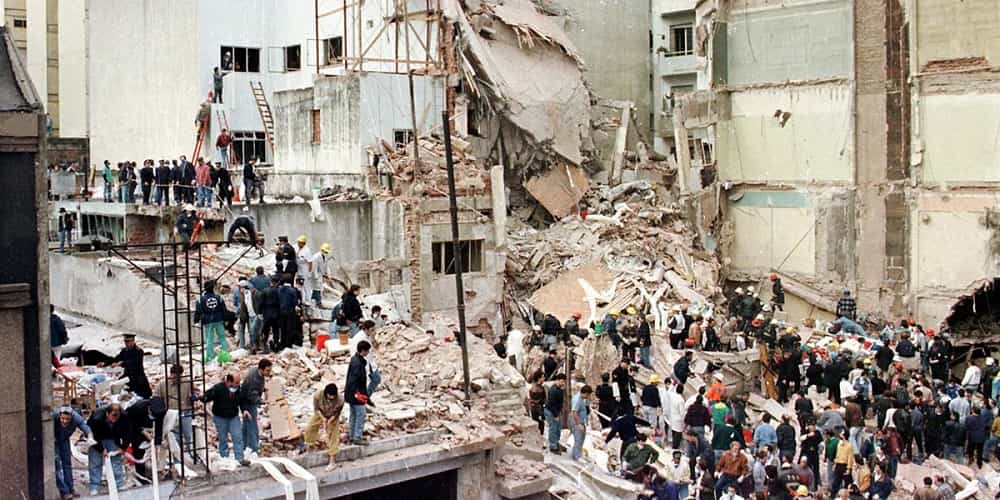
The attack, which resulted in 85 deaths and hundreds of injuries, remains one of the most devastating terrorist acts in Argentina’s history.
The report, known as the “Toma Report,” was compiled by Miguel Ángel Toma, the former head of Argentina’s Secretariat of Intelligence (SIDE). This comprehensive document has played a pivotal role in the ongoing judicial proceedings, revealing intricate details of Iran’s orchestration of the bombing through its proxy, Hezbollah.
The declassification of the Toma Report occurred shortly before the Inter-American Court of Human Rights condemned Argentina for its mishandling of the AMIA case. The report underscores the Iranian regime’s meticulous planning and execution of the bombing, facilitated by Hezbollah operatives. Key figures, such as Mohsen Rabbani, the then cultural attaché of Iran in Argentina, are identified as principal orchestrators.
The investigation drew on extensive data, including information from the CIA, to map out Iran’s covert operations in South America, utilizing mosques and other institutions as fronts for intelligence activities. The executive summary of the report states: “The highest authorities of the Islamic Republic of Iran and Hezbollah gave the order for the attack against the AMIA to be perpetrated. There is evidence of the involvement of the Hezbollah leadership in the critical and final phases of the attack.”
THREAD
For more than four decades, the clerical regime in #Iran has consistently blackmailed other nations and considered #extremism as "leverage". 1/9https://t.co/ieaaOkZb6y pic.twitter.com/W9u5BJHXqs— NCRI-FAC (@iran_policy) September 6, 2022
This revelation has not only highlighted Iran’s deep involvement but also exposed the operational network responsible for the AMIA bombing and the earlier attack on the Israeli Embassy in Buenos Aires. Both attacks are attributed to the same Iranian-Hezbollah nexus.
The Toma Report’s findings were instrumental for Alberto Nisman, the late Argentine prosecutor who spearheaded the investigation into the AMIA bombing. Using the report, Nisman secured Interpol red notices against several high-ranking Iranian officials. Despite these efforts, justice remains elusive, partly due to political interference.
Former President Cristina Fernández de Kirchner’s administration faced allegations of a cover-up to protect Iranian officials in exchange for favorable trade deals. This controversial memorandum of understanding between Argentina and Iran was widely criticized as undermining the quest for justice. Suspicion also surrounds Kirchner’s administration regarding Nisman’s mysterious death in 2015, shortly after he accused her of obstructing his investigation.
#Nisman is a martyr for peace and humanity and not just a martyr of the Argentinean people#Iran pic.twitter.com/hstAbPWHAk
— Maryam Rajavi (@Maryam_Rajavi) January 29, 2015
The release of the Toma Report marks a critical step forward for the victims’ families, who have long demanded transparency and accountability. However, they continue to face challenges in accessing the full scope of classified documents due to complex legal and bureaucratic hurdles. The National Council of Resistance of Iran (NCRI) has repeatedly condemned Tehran’s terrorist activities and supported the declassification of such reports. Following Nisman’s death.

MEK Iran (follow us on Twitter and Facebook), Maryam Rajavi’s on her site, Twitter & Facebook, NCRI (Twitter & Facebook), and People’s Mojahedin Organization of Iran – MEK IRAN – YouTu