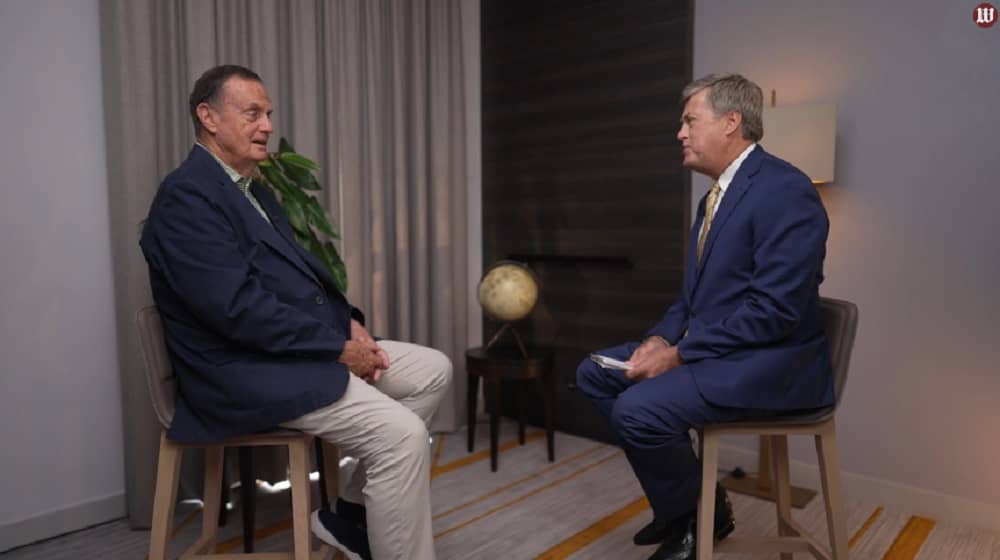
Drawing from his extensive experience and unique insights, General Jones critiqued the fluctuating U.S. stance on Iran, particularly under the current administration.
Jones, who served as Obama’s National Security Advisor from 2009 to 2010, recounted his introduction to the People’s Mojahedin of Iran (PMOI/MEK) after leaving the White House. He described a transformative moment in 2011 when he received a distressing call from Camp Ashraf, the MEK’s base in Iraq, under attack by the Iraqi Army.
“I got a call in the middle of the night from someone at Camp Ashraf. I could hear gunfire in the background. It was particularly troubling because the American Army had granted the MEK members safe conduct ID cards after disarming them in 2003,” Jones recalled. “The fact that innocent people were being shot at by Iraqi soldiers using American weapons and Humvees was outrageous.”
Jones immediately contacted Admiral Mullen, then Chairman of the Joint Chiefs, and General Jim Mattis, Commander of CENTCOM, to alert them to the situation. Despite his efforts, he felt the U.S. response was inadequate. Addressing the inconsistency in U.S. foreign policy, General Jones highlighted how the changing stances from one administration to another have sown confusion among allies and adversaries alike.
Updated: Exclusive: Ex-Marine general, Obama security advisor calls for U.S. be much tougher on Iran https://t.co/0PbcDVp6oS
— Just the News (@JustTheNews) June 30, 2024
“Our friends, allies, and enemies are confused by American foreign policy because it can change on a dime,” Jones stated. “Where Iran is concerned, our policy has vacillated between appeasement and a harder line, but without definitive action to induce behavioral change in Iran.” Jones was particularly critical of the current administration’s approach to the Iranian regime, describing it as bordering on appeasement. He argued that the belief in Tehran’s potential shift towards moderation is mistaken.
“There has been a mistaken belief that Iran will somehow see the light and stop pursuing nuclear weapons. The evidence has proven this incorrect,” he asserted.
Expressing his admiration for Iranian opposition President-elect Maryam Rajavi of the National Council of Resistance of Iran (NCRI), and her vision for a democratic Iran, Jones noted, “I’ve known Maryam Rajavi for the better part of a decade. Her Ten-Point Plan for the future of Iran is Jeffersonian in its democratic values. Anyone who supports a truly democratic regime should align with these values.”
General Jones emphasized the importance of taking the NCRI and MEK seriously, citing Iran’s relentless efforts to eradicate these groups as indicative of their significance. “Iran pays close attention to the NCRI and MEK, evidenced by their continuous attacks on Camp Ashraf and now in Albania. This should tell us something about their importance,” he stated.
Gen. James Jones: #Tehran Leverages #Terrorism to Divert Attention from Internal Unresthttps://t.co/eDPHb2JDYv
— NCRI-FAC (@iran_policy) November 3, 2023
In his concluding remarks, General Jones called for a clear and consistent U.S. policy that does not reward destructive and dangerous behavior by the Iranian regime. He advocated for immediate and decisive action in response to Iranian aggression. He emphasized that any change in Iran must come from within, with support from organizations like the NCRI and MEK.
“The Iranian people, with the leadership of organizations like the NCRI, will eventually reassert themselves for the future of their great country,” Jones concluded. “It’s going to have to come from within, and we should not diminish our enthusiasm for this change.”

MEK Iran (follow us on Twitter and Facebook), Maryam Rajavi’s on her site, Twitter & Facebook, NCRI (Twitter & Facebook), and People’s Mojahedin Organization of Iran – MEK IRAN – YouTu