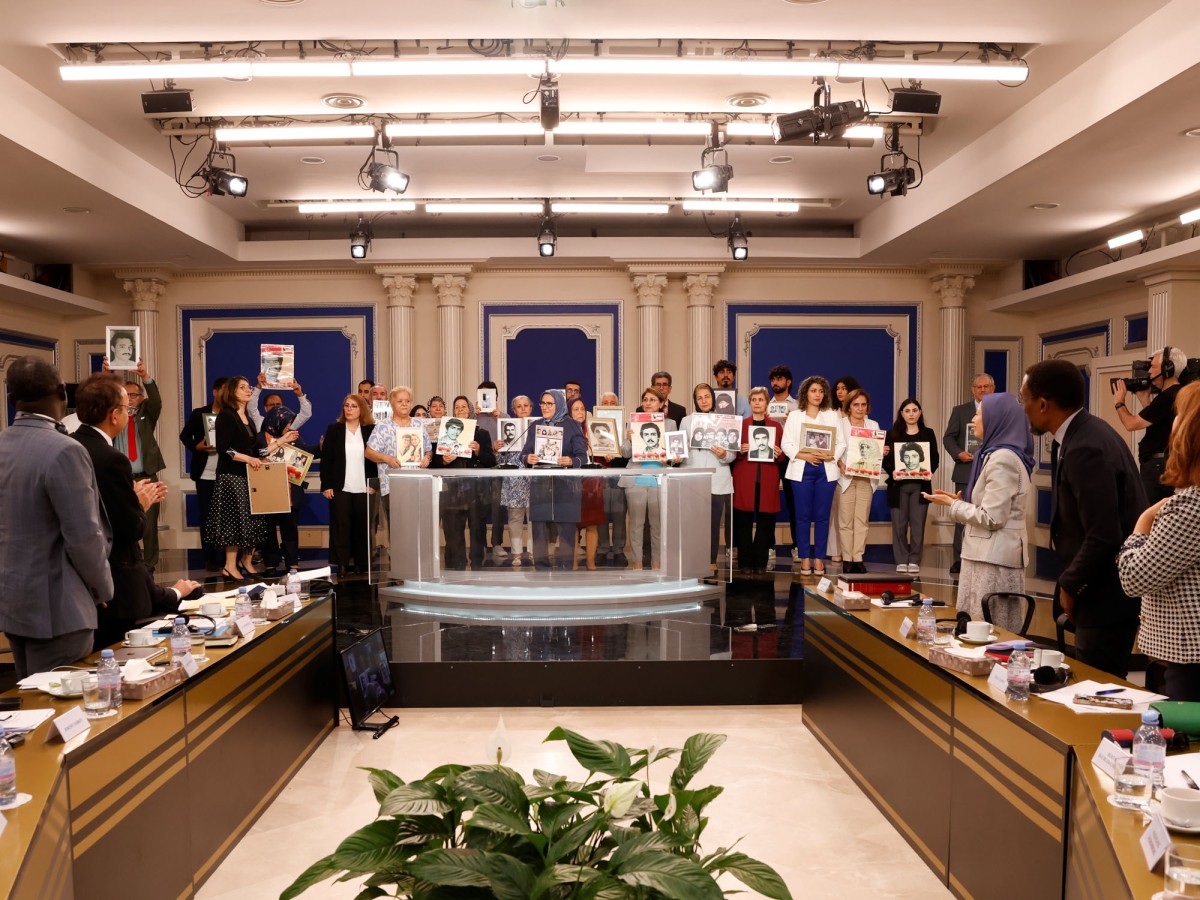
The conference focused on the 1988 massacre, as well as the mass executions of 1981 and 1982, demanding an end to the impunity enjoyed by those responsible for these heinous acts.
The conference brought together a distinguished panel of international jurists, scholars, and human rights advocates, including former officials of the International Criminal Court (ICC) and the United Nations. Their collective expertise underscored the gravity of the situation and the urgent need for accountability. Notable attendees included Professor Chile Eboe-Osuji, former ICC President, and Professor Javaid Rehman, UN Special Rapporteur on human rights in Iran from 2018 to 2024.

Maryam Rajavi, a prominent leader of the Iranian opposition, opened the conference with a powerful speech, highlighting the regime’s long-standing reliance on violence and repression to maintain control. She condemned the recent wave of executions under Iran’s current leadership, which saw 126 prisoners executed in a single month, and linked these acts to a broader pattern of brutality spanning 45 years.
Rajavi also called attention to the 1988 massacre, during which an estimated 30,000 political prisoners were executed—many of them members of the PMOI. She framed this massacre as a genocide, echoing the findings of Professor Rehman, who labeled these executions as crimes against humanity. Rajavi stressed that the perpetrators, including high-ranking officials in the current Iranian regime, must be held accountable under international law.

The conference also highlighted the international community’s failure to respond to these atrocities. Despite extensive evidence, including testimonies of survivors and detailed reports from various human rights organizations, world leaders have largely remained silent. Rajavi urged governments and the United Nations to pursue criminal investigations and prioritize accountability mechanisms.
This landmark event stands as a clarion call for justice. As the panelists stressed, ending impunity for Iran’s atrocity crimes is not just about accountability for the past but also about preventing future violations.