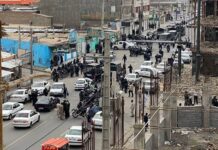
Demonstrations erupted across major cities, including Tehran, Isfahan, Shiraz, and Borujerd, highlighting the growing discontent with the government’s handling of economic and infrastructural challenges.
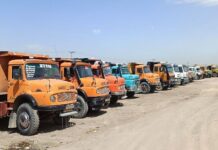
In Tehran, protesters from the industrial hubs of Saba, Golgoon, and Arvin blocked the Tehran-Saveh highway by setting tires ablaze. These demonstrators, angered by prolonged power outages, warned that continued government inaction threatens their livelihoods and could lead to widespread financial collapse. Meanwhile, workers from Tehran’s oil refinery rallied against delayed wages, demanding immediate compensation and systemic reforms to prevent further delays.
December 16—Tehran, Iran
Residents of Saba, Golgoon, and Arvin industrial cities block the Tehran-Saveh road with fire in protest to power outages. #IranProtestspic.twitter.com/nJDPdJtnRX— People's Mojahedin Organization of Iran (PMOI/MEK) (@Mojahedineng) December 16, 2024
Retirees have also joined the escalating unrest. Outside the Social Security Organization headquarters in Tehran, pensioners criticized the government for corruption, inadequate pensions, and declining living conditions. Their slogans condemned officials for ignoring their plight. In Shiraz, retirees of the Telecommunications Company of Iran (TCI) protested against pension mismanagement, accusing the regime of misusing funds.
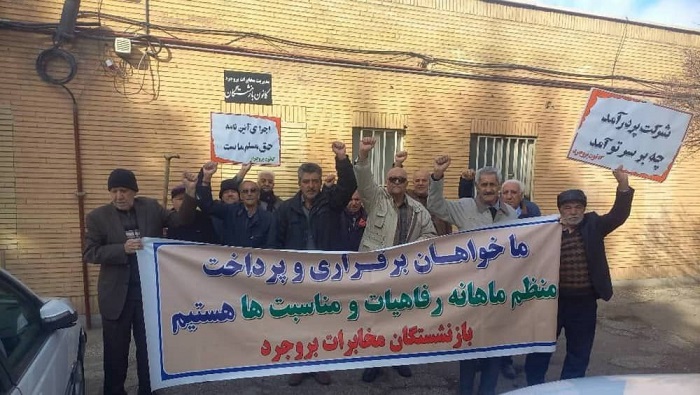
Similar demonstrations unfolded in Borujerd, where telecommunications retirees demanded long-promised reforms and decried poor living standards. Protesters carried banners reading, “Implementing regulations is our undeniable right.” The nationwide power outages have further fueled tensions, particularly in industrial areas.
December 16—Borujerd, western Iran
Retirees of the national telecommunications company continue protests as authorities refrain from addressing their demands for higher pensions and better living conditions.#IranProtests pic.twitter.com/qYunEIX5QZ— People's Mojahedin Organization of Iran (PMOI/MEK) (@Mojahedineng) December 16, 2024
Business owners in Isfahan and Nassim Shahr reported significant financial losses, with some forced to temporarily shut down operations. A prominent business owner in Isfahan publicly condemned the government for its failure to maintain essential services, underlining the cascading effects on commerce and production.
Adding to the unrest, an incident in Javanrud, Kermanshah Province, has drawn widespread outrage. Security forces fatally shot a 20-year-old man, Soheib Ahmadi, in the Baba Jani neighborhood on December 15. Struck by multiple bullets, Ahmadi’s death has become a flashpoint for protests against the regime’s violent suppression of dissent.
December 16—Tehran, Iran
Welders of Tehran's oil refinery rally to protest months-delayed wages.#IranProtestspic.twitter.com/4intjGBZwQ— People's Mojahedin Organization of Iran (PMOI/MEK) (@Mojahedineng) December 16, 2024
These demonstrations underscore the mounting pressure on Iran’s government to address systemic mismanagement. With protests spreading across the nation and encompassing various sectors, public trust continues to erode. As economic hardships intensify, calls for transparency, reform, and accountability grow louder, leaving the government grappling with escalating demands for change.

MEK Iran (follow us on Twitter and Facebook), Maryam Rajavi’s on her site, Twitter & Facebook, NCRI (Twitter & Facebook), and People’s Mojahedin Organization of Iran – MEK IRAN – YouTu