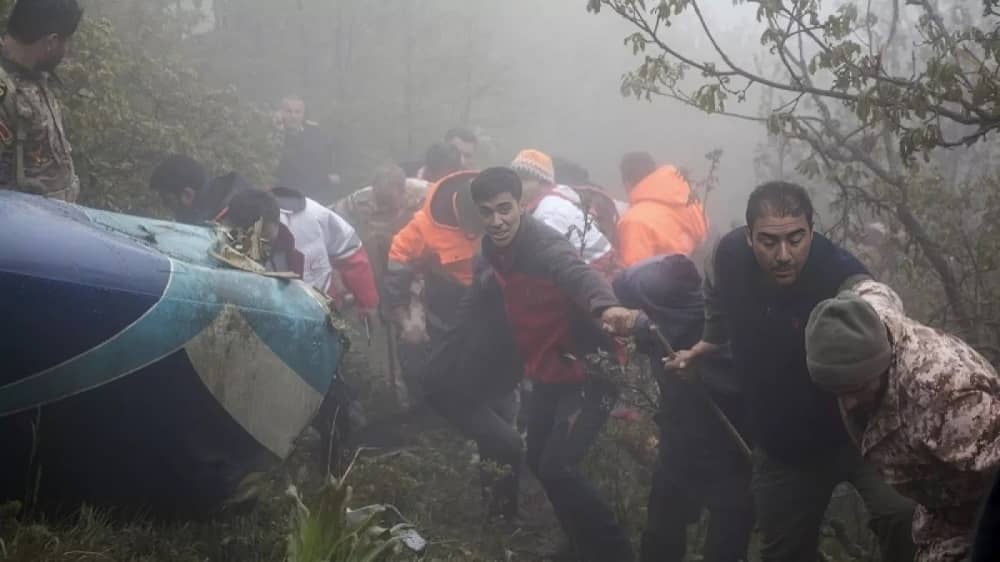
The crash, which occurred on May 19, claimed the lives of Raisi and eight other officials, including Foreign Minister Hossein Amir-Abdollahian, when their helicopter went down in the forests of Varzaqan in East Azerbaijan Province. Initial reports from the IRGC-affiliated Fars News Agency suggested the helicopter was overloaded and faced bad weather.
However, these claims were swiftly countered by the General Staff of the Armed Forces, which labeled the report “invalid and discredited,” denying overloading and adverse weather as causes.
The regime’s delay in announcing the deaths for 18 hours only fueled rumors and skepticism among Iranians. For many, Raisi’s death marked a moment of relief. Known as the “Butcher of Tehran” for his role in the mass executions of political prisoners in the 1980s, Raisi was a symbol of the regime’s brutal repression. His death, therefore, was seen by many as a significant blow to an oppressive government.
Raisi’s untimely death has created a significant power vacuum within the Iranian regime. As a trusted ally of Supreme Leader Ali Khamenei, Raisi played a pivotal role in efforts to consolidate power amidst rising domestic unrest and international isolation. His sudden death disrupted these plans, leading to intense infighting among various factions vying for control over the executive branch.
In the 16 hours it took the clerical regime in #Iran to announce #Raisi's disappearance and finally declare his death, three decades of military boasting and bravado were put in jeopardy. pic.twitter.com/X4McgbbFCm
— NCRI-FAC (@iran_policy) May 28, 2024
This internal power struggle forced Khamenei to call for early presidential elections, aiming to restore stability. However, these elections, widely perceived as fraudulent, resulted in a nationwide boycott, highlighting the regime’s eroding legitimacy.
The ambiguity surrounding the crash’s cause has further deepened the crisis. Iranian officials have alternated between explanations, citing mechanical failure, human error, and environmental factors, but none have been conclusively proven or universally accepted. This lack of clarity has only fueled speculation and distrust among the Iranian public, revealing deeper issues within the government.
The regime now faces a critical dilemma: revealing the truth could expose its incompetence or hint at internal sabotage or foreign interference, potentially sparking public dissent. On the other hand, continuing to obscure the facts only erodes its credibility and authority further. This situation mirrors the regime’s handling of the downing of the Ukrainian passenger plane PS752 in January 2020, which was shot down by the IRGC, killing 176 people.
#Raisi’s Death Cripples Khamenei’s Decade-Long Project to Maintain Rule over #Iran https://t.co/ibcs5oMwbB
— NCRI-FAC (@iran_policy) May 22, 2024
Initially, the government denied involvement, only to later admit, under international pressure, that the IRGC had mistakenly fired missiles at the aircraft. This pattern of deception and cover-up, now seen again with Raisi’s helicopter crash, suggests a regime that is more fragile and weakened than ever before. The ongoing struggle for power and transparency highlights a regime grappling with its legitimacy and survival.