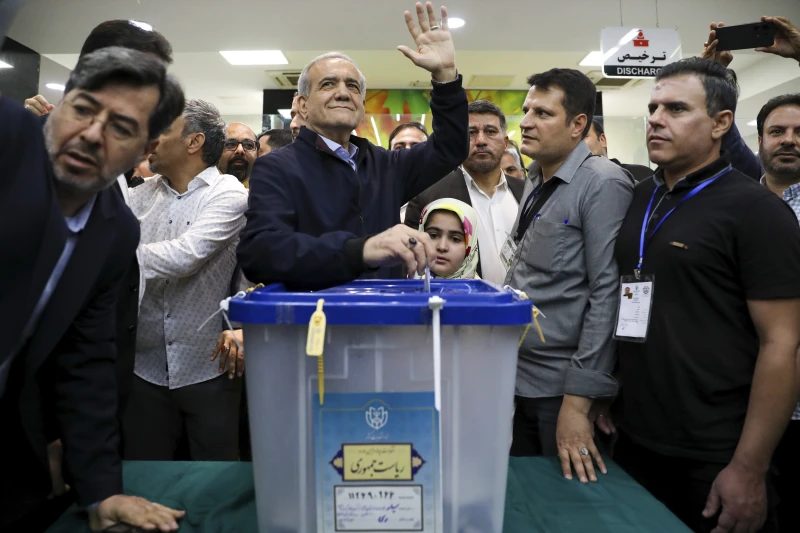
According to Iranian opposition President-elect Maryam Rajavi of the National Council of Resistance of Iran (NCRI), the election was a desperate move by Supreme Leader Ali Khamenei to maintain the regime’s grip on power. However, this strategy has backfired, pushing the regime closer to collapse.
A significant indicator of the public’s disillusionment was the massive boycott of the election, with an astounding 91% of eligible voters abstaining. This overwhelming non-participation signifies a clear rejection of the entire theocratic system, leaving Khamenei as the strategic loser of this electoral exercise.
The death of Ebrahim Raisi and the subsequent shattering of Khamenei’s plans to purify the regime have created a new political equilibrium, drawing parallels to the final days of the Shah’s regime.
The election boycott also underscored the obsolescence of the “reformists” vs. “hardliners” narrative. Despite efforts by figures such as Mohammad Khatami, Hassan Rouhani, and Javad Zarif to encourage voter turnout, the Iranian people largely dismissed their appeals. This collective rebuff has dealt a severe blow to the already weakened Supreme Leader, causing internal power struggles within the regime to intensify.
Yesterday's election farce was a scandalous fabrication meant to cover up the widespread boycott, the overwhelming "no" to religious despotism, and the decisive vote to overthrow the clerical regime and establish a democratic republic, as expressed by the people of #Iran in four…
— Maryam Rajavi (@Maryam_Rajavi) July 6, 2024
Masoud Pezeshkian, the newly “elected” president, is not seen as a reformist. He has openly stated that his policies align strictly with Khamenei’s directives, declaring his loyalty to the Supreme Leader and the regime’s founder, Ruhollah Khomeini. This adherence to the status quo starkly contrasts with the Iranian people’s aspirations for freedom and democracy.
The Iranian Resistance, led by Mrs. Rajavi, has outlined specific actions that could test Pezeshkian’s commitment to change, should he choose to deviate from the regime’s oppressive policies. These actions include canceling the mandatory hijab, releasing political prisoners, abolishing the death penalty, removing internet censorship, disbanding revolutionary courts, and securing workers’ rights. Such measures align with the people’s modest expectations and highlight the significant disconnect between the regime’s policies and citizens’ basic rights.
Amidst economic hardships, regional conflicts, and internal dissent, the regime finds itself increasingly cornered. Mrs. Rajavi’s assertion that the regime is in its “overthrow phase” underscores the fundamental incompatibility between the Iranian people’s democratic aspirations and the regime’s authoritarian nature.
#Raisi’s Death Cripples Khamenei’s Decade-Long Project to Maintain Rule over #Iran https://t.co/ibcs5oMwbB
— NCRI-FAC (@iran_policy) May 22, 2024
The international community faces a crucial juncture in Iran’s history. Rather than legitimizing a flawed electoral process, world leaders should support the Iranian people’s quest for genuine democracy and human rights.
In conclusion, the recent election has only further exposed the regime’s vulnerabilities and isolation. As Mrs. Rajavi predicts, “The clerical regime will be overthrown by the Iranian people through their uprisings and organized resistance. A democratic republic will be established in Iran.”

MEK Iran (follow us on Twitter and Facebook), Maryam Rajavi’s on her site, Twitter & Facebook, NCRI (Twitter & Facebook), and People’s Mojahedin Organization of Iran – MEK IRAN – YouTu