This fixation is evident in the regime’s persistent show trials, which, despite international condemnation, serve as a platform to broadcast its grievances against the MEK to both the Iranian public and the global community.
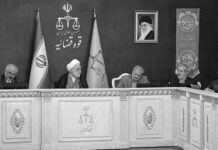
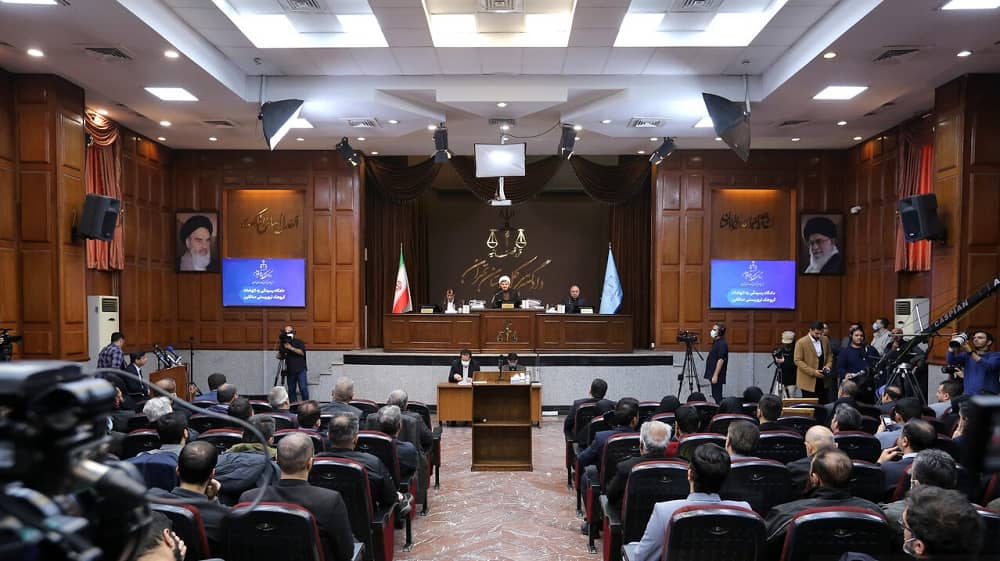
On August 14, Tehran hosted the latest session of this ongoing series of show trials. The session prominently featured the regime’s deep-seated anxieties over the most recent report by Javaid Rehman, the United Nations Special Rapporteur on the situation of human rights in Iran. Throughout the proceedings, those involved repeatedly addressed Western countries, attempting to justify the regime’s brutal actions under the pretext of combating terrorism.
A central figure in the trial, presented as a lawyer named Molaei, argued that under Islamic jurisprudence, the crime of ‘Baghi’ (rebellion) is akin to anti-terrorism laws. Another figure, introduced as a jurisprudence expert named Sedaqat, added, “In the context of Islamic jurisprudence, if even a few members of a group commit a terrorist act, the entire group is considered ‘Baghi,’ and as a result, all members of the group are sentenced to death.”
Justice in Absurdity: #Iran’s Lawless Dictator Holds Trial of Sworn Enemieshttps://t.co/gMVIRpmuT0
— NCRI-FAC (@iran_policy) December 25, 2023
In a revealing exchange, the presiding judge, whose strict demeanor underscored the regime’s seriousness in these trials, asked, “Does supporting and encouraging terrorist groups make someone a terrorist?” Sedaqat responded affirmatively, stating that a supporter who is a member of the group is indeed a terrorist, as ‘Baghi’ represents the highest degree of terrorism. He also referenced the controversial events of the 1980s, when the Islamic Republic faced scrutiny for executing members of the MEK.
Sedaqat further attempted to justify the 1988 massacre of 30,000 political prisoners, many of whom were affiliated with the MEK, by rebranding the so-called “Death Committees” as “committees of pardon” that aimed to save the prisoners through expedited judicial proceedings.
He contended that these committees, formed in each province, were tasked with determining the fate of the prisoners, to grant pardons rather than impose executions. According to Sedaqat, these committees operated under the orders of Imam Khomeini, the regime’s first Supreme Leader, who purportedly sought to save prisoners by encouraging them to renounce their affiliation with the MEK.
In a chilling moment, the presiding judge asked Sedaqat whether imprisoned members of the MEK were indeed given another trial with a focus on forgiveness. Sedaqat confirmed, arguing that the three-member committees, acting on Khomeini’s orders, had saved thousands from execution by removing them from the legal category of ‘Baghi.’ He portrayed the trials as demonstrations of the rule of law in the Islamic Republic of Iran, insisting that defendants had ample opportunity to defend themselves.
The session concluded with a stark warning from the plaintiffs’ lawyer, who condemned Western countries for providing refuge to the MEK. Molaei accused nations such as the United Kingdom, France, and Albania of hypocrisy, claiming they supported democratic values while sheltering individuals who allegedly sought to destroy political parties.
Iran’s continued show trials reveal a regime struggling to maintain its grip on power, resorting to legal theater in a bid to silence opposition and legitimize its repressive actions. Despite the regime’s efforts, these trials have only deepened its isolation on the global stage, as the international community grows increasingly critical of its human rights record.

MEK Iran (follow us on Twitter and Facebook), Maryam Rajavi’s on her site, Twitter & Facebook, NCRI (Twitter & Facebook), and People’s Mojahedin Organization of Iran – MEK IRAN – YouTu