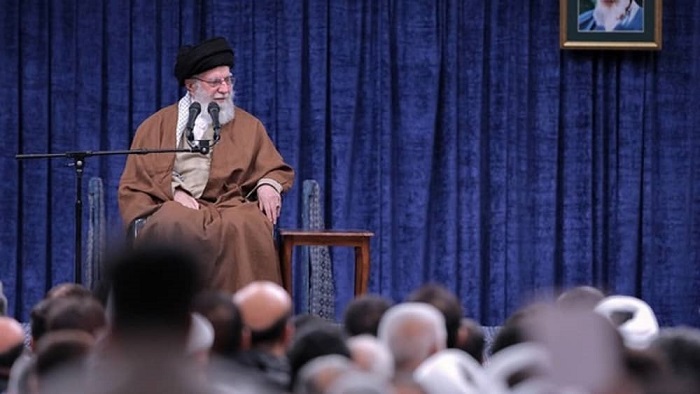
In the face of growing criticism from state media and officials urging a reassessment of Tehran’s costly regional strategy, Khamenei doubled down, rejecting any course correction and portraying the setback as a transient challenge within a larger ideological struggle.
Khamenei attributed Assad’s downfall to a foreign conspiracy orchestrated by the United States and Israel, dismissing the role of the Syrian people. “There should be no doubt that what happened in Syria is the product of a joint American-Zionist plot,” he declared. Accusing a “neighboring state” of complicity, he insisted that “evidence leaves no room for doubt.” However, his rhetoric sidestepped mounting calls within Iran’s establishment to reconsider its regional policies, particularly in light of the economic and human toll of its involvement in Syria.
Despite his firm stance, Khamenei’s tone betrayed the regime’s recognition of internal and regional discontent. By framing the situation as a test of the so-called Resistance Front’s resilience, he sought to inspire his supporters. “This is resistance,” he claimed. “Under pressure, resistance grows stronger. With divine help, its reach will expand across the region like never before.”
#Iran #News: Khamenei Rallies Basij Amid Fears of Protests and Pressure to Change His Regional Strategy https://t.co/L6oe0jFAu7
— NCRI-FAC (@iran_policy) November 27, 2024
Khamenei’s insistence on perseverance contrasts with the growing dissent among his power bases. Even loyalists have acknowledged the strategic defeat in Syria, where Iran’s financial and military investments failed to secure Assad’s regime. Reports from state media have highlighted the burdens of Tehran’s regional ambitions, exacerbating economic struggles and domestic discontent.
In his speech, Khamenei lashed out at domestic and foreign media for their critical coverage. He accused foreign outlets of “spreading fear” and “emptying the hearts of the people,” while demanding internal critics align with the regime’s narrative. This sharp rhetoric underscores the regime’s growing unease as it grapples with rising disillusionment among its supporters.
Notably, the speech was not broadcast live on state television, signaling the regime’s cautious management of public perception. Khamenei’s claim that Iranian intelligence had warned Assad’s regime of the impending crisis, while shifting blame, also acknowledged internal failures in communication and strategy.
#Khamenei’s Post-Strike Address Exposes Fears of Regional Setbacks and Regime Insecurityhttps://t.co/CNStufiQYC
— NCRI-FAC (@iran_policy) October 28, 2024
Ultimately, Khamenei’s speech reflected a mix of defiance, denial, and morale-boosting promises. His determination to sustain Iran’s regional posture at all costs highlights the cracks in Tehran’s ambitions and the growing strain on his regime’s foundation. The fall of Assad has exposed vulnerabilities not only in Iran’s foreign policy but also in the broader stability of Khamenei’s rule.

MEK Iran (follow us on Twitter and Facebook), Maryam Rajavi’s on her site, Twitter & Facebook, NCRI (Twitter & Facebook), and People’s Mojahedin Organization of Iran – MEK IRAN – YouTu