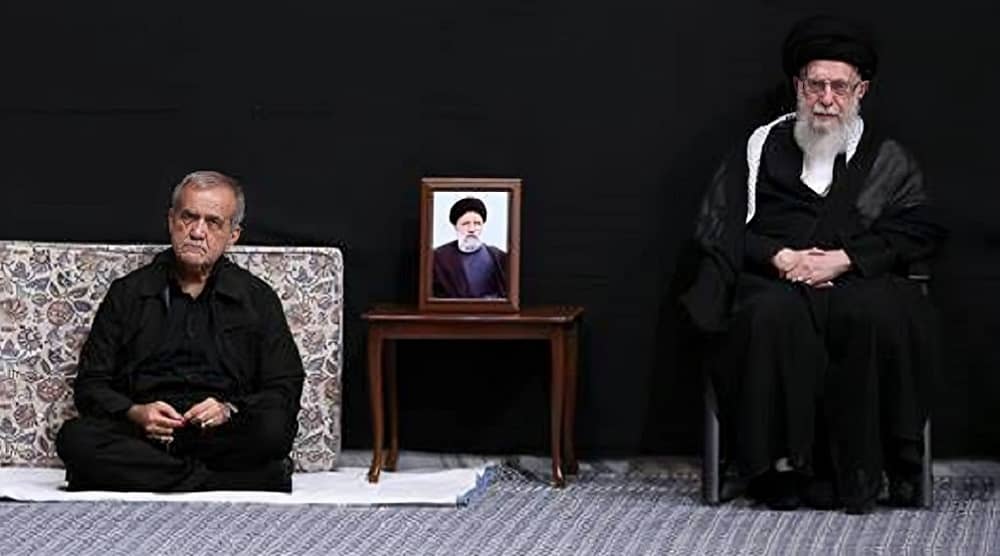
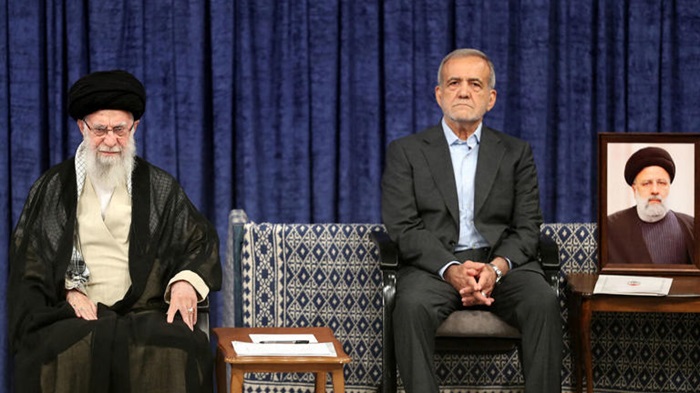
The ceremony, marked by its cold and silent atmosphere, saw Iran’s Supreme Leader, Ali Khamenei, endorsing Pezeshkian under the condition of being “fit for duty.” In his decree, Khamenei described Pezeshkian as “wise, honest, popular, and learned” but emphasized that his confirmation would persist only if Pezeshkian’s path aligned with “the true course of Islam and the revolution.” This caveat underscored the conditional nature of Khamenei’s approval.
Pezeshkian responded by reaffirming his commitment to the regime’s principles and key figures, including the founder of the Islamic Republic, Ruhollah Khomeini, and former IRGC Quds Force commander, Qasem Soleimani. He also paid tribute to former presidents Mohammad-Ali Rajai, Ebrahim Raisi, and former prime minister Mohammad-Javad Bahonar, expressing gratitude for the Supreme Leader’s guidance.
Pezeshkian’s submission to Khamenei’s vision was evident as he stated, “The mission and responsibility of myself and the future government are to adhere to the vision defined by the Supreme Leader and the general policies he has communicated.” However, Khamenei’s expectations extended beyond this general adherence.
Popular Capacity: Khamenei emphasized using the regime’s concept of “popular capacity,” which implies rejecting reforms linked to the United States.
Jihadi Work: He urged Pezeshkian to emulate the “jihadi work” of former president Raisi, who was notorious for a record 834 executions in one year. Khamenei highlighted that such relentless efforts were crucial in countering the enemy’s plots over the past decades.
Interaction with the Majlis: Khamenei stressed the importance of cooperation between the government and the parliament, insisting that the government must heed the parliament’s sensitivities. He recommended regular meetings among the heads of the three branches to ensure alignment.
Further, Khamenei highlighted the judiciary’s and armed forces’ roles in suppressing uprisings, instructing the judiciary to maintain an active presence and the armed forces to support the government and people as needed.
In terms of foreign policy, Khamenei drew inspiration from the deceased foreign minister Amir Abdollahian, a protégé of Qasem Soleimani, and directed that Abdollahian’s efforts continue. Khamenei concluded by underscoring Gaza’s significance in addressing the regime’s crises, declaring, “Today, Gaza is a global issue. The issue of Palestine and Gaza is a universal global issue.”
These directives indicate that Khamenei plans to perpetuate Raisi’s legacy of increasing executions, suppressing dissent, and supporting regional terrorism. The ongoing rise in executions and the flow of weapons to the regime’s proxies highlight the need for significant change, which many believe can only come from the people of Iran overthrowing the regime.