This infighting directly contradicts Supreme Leader Ali Khamenei’s calls for unity and adherence to the administration of the late President Ebrahim Raisi.
In a widely circulated note, he criticized, “It seems that the slogan ‘everything for Iran’ before the elections has turned into ‘everything for the Ministry.’ I implore all committee members to stop demanding their share of the cake for the sake of Iran and the unfortunate Dr. Pezeshkian. I suggest that the chairperson and all committee members be prohibited from holding any positions or titles.”
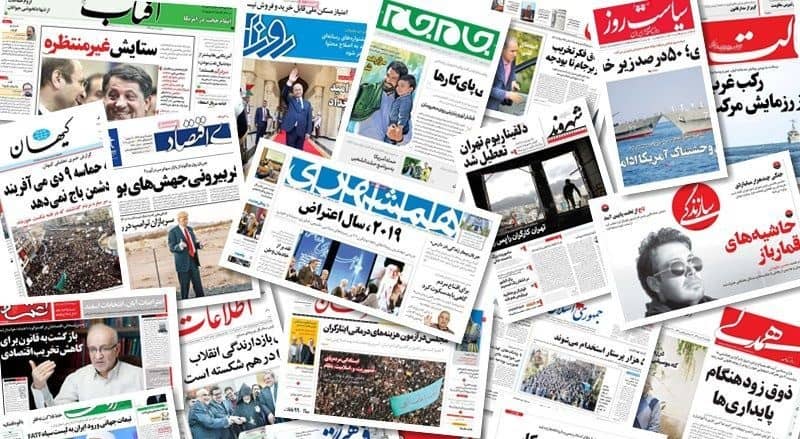
Amid these tensions, the state-run Kayhan newspaper praised Raisi’s administration for leaving behind a strong foundation, claiming it had handed over a “saddled horse.” However, the Ham-Mihan newspaper retorted, “Those who handed over this saddled horse, why didn’t they ride it a bit so the people could enjoy their horsemanship? Today’s inflation is unprecedented in the last 80 years.” Similarly, Mostaghel Online criticized the electricity sector, claiming the “saddled horse” was equipped with a “time bomb.”
Etemad Online questioned the legitimacy of the “saddled horse” narrative, asking, “If the thirteenth government is handing over a saddled horse to Pezeshkian, why did the people refuse to vote for the candidate of that saddled horse?” Sazandegi newspaper highlighted Raisi’s massive debt legacy of 775 trillion tomans, questioning whether the new administration received a “saddled horse or scorched earth.”
Khabar Online, associated with former Parliament Speaker Ali Larijani, acknowledged the regime’s declining legitimacy, noting high blank vote rates in Tehran, Khorasan Razavi, and Isfahan, reflecting widespread public disillusionment.
Meanwhile, state officials and media attacked Saeed Jalili, a Khamenei aide and failed presidential candidate, for his claim to form a “shadow government.” Critics like former Tehran mayor Gholamhossein Karbaschi, ex-parliament member Hossein Naghavi Hosseini, and former presidential chief of staff Mahmoud Vaezi dismissed Jalili’s legitimacy and feasibility. Jalili had declared his intention to take action if Pezeshkian failed.
Karbaschi questioned, “What authority does he have to form a shadow government?” Naghavi Hosseini remarked, “A shadow government requires financial and logistical support. I know there’s no budget line for Jalili’s shadow government. He should come into the sunlight and clarify.” Mahmoud Vaezi also warned, “Who is Jalili to say he will step in if Pezeshkian doesn’t perform well? It’s dangerous for someone who lost to say they want to form a shadow government.”
Reasons Behind #Khamenei’s Forced Approval of Masoud Pezeshkian in #Iran’s Sham Electionhttps://t.co/OC0zjoxuLn
— NCRI-FAC (@iran_policy) July 11, 2024
Alireza Alavitabar, an advisor to former President Mohammad Khatami, expressed concern about the regime’s future, warning that if President-elect Masoud Pezeshkian’s cabinet continues current policies, the system faces potential collapse. He warned, “If Pezeshkian’s cabinet symbolizes the continuation of the current situation, we are all doomed. No longer can the people be invited to elections that fail to end deadlocks.”
Meanwhile, U.S. internal politics also affected Iran, as Kayhan criticized the appointment of J.D. Vance as Donald Trump’s vice-presidential candidate, labeling it bad news for Iran’s “moderate factions” who support engagement with the West. Kayhan wrote, “This is ‘bad news for domestic Westernizers’ because Vance has called the JCPOA a disastrous agreement.” The state-run Chand Sanieh website highlighted Vance’s hardline stance against the Iranian regime, predicting tougher policies.

MEK Iran (follow us on Twitter and Facebook), Maryam Rajavi’s on her site, Twitter & Facebook, NCRI (Twitter & Facebook), and People’s Mojahedin Organization of Iran – MEK IRAN – YouTu