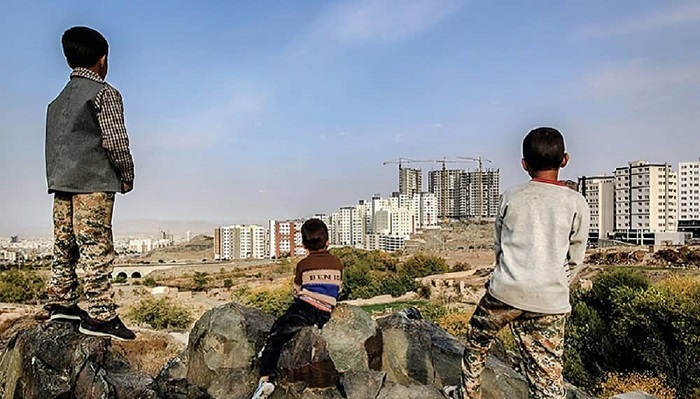
Reports reveal that the National Land and Housing Organization, under the Ministry of Roads and Urban Development, currently holds 1.8 million hectares of land in urban areasa space large enough to build nearly 30 cities the size of Tehran. Despite this extensive inventory, skyrocketing prices and stagnant wages make homeownership a distant dream for most Iranians.
Mohammad Bagher Ghalibaf, Speaker of Iran’s Parliament, highlighted the scale of government-controlled land holdings, acknowledging that the organization holds “double the total area of residential land in the entire country.” Ghalibaf’s statement was seen by many as a reaction to mounting public pressure rather than empathy for citizens’ struggles.
Officials often sidestep responsibility, attributing the housing crisis to a “shortage of land.” Yet, the monopoly on vast tracts of land continues to push prices far beyond the reach of ordinary Iranians, particularly in Tehran, where housing costs now surpass 120 million tomans per square meter.
Kazem Sedighi, A Khamenei Ally, Exposed to Have Grabbed Billions Worth of Land in #Iran's Capitalhttps://t.co/CmbzjfHMsP pic.twitter.com/cze9r5g7rI
— NCRI-FAC (@iran_policy) March 18, 2024
The financial strain has grown untenable, with over 55% of household expenses in Tehran Province allocated to housing alone, far above the global standard of 30%. This disproportionate burden forces many families into economic hardship, with some moving to suburban or remote areas in search of affordable living. Between 2013 and 2016, urban building permits hit historic lows, and with limited housing production, the supply-demand gap continues to widen. Over the past decade, the market has experienced a dozen price surges, with rental rates tripling since the start of the 2010s.
In January, Hossein Raghfar, an economist associated with the state, criticized the government’s focus on “productive assets plans,” warning that it benefits a select few rather than the public. Concerns also grow over the influence of the Islamic Revolutionary Guard Corps (IRGC), which dominates Iran’s economy and stands to gain further from land privatization efforts.
The recently leaked documents expose the Iranian regime's favoritism towards the #IRGCterrorists under President Raisi's administration. Land transfers, funding requests – it's clear where the regime's #priorities lie.https://t.co/BQR3mVPIC7
— NCRI-FAC (@iran_policy) June 11, 2023
Experts argue that releasing even a fraction of the Ministry’s land holdings could alleviate the housing shortage. However, under a regime that has repeatedly prioritized its own interests, expectations for reform remain low.With public anger rising, Iranians are demanding greater accountability from officials whose wealth-hoarding practices worsen economic pressures on struggling households. Far from offering solutions, the Ministry of Roads and Urban Development’s expanded control over urban land is intensifying the crisis and leaving citizens with limited hope for change.

MEK Iran (follow us on Twitter and Facebook), Maryam Rajavi’s on her site, Twitter & Facebook, NCRI (Twitter & Facebook), and People’s Mojahedin Organization of Iran – MEK IRAN – YouTu