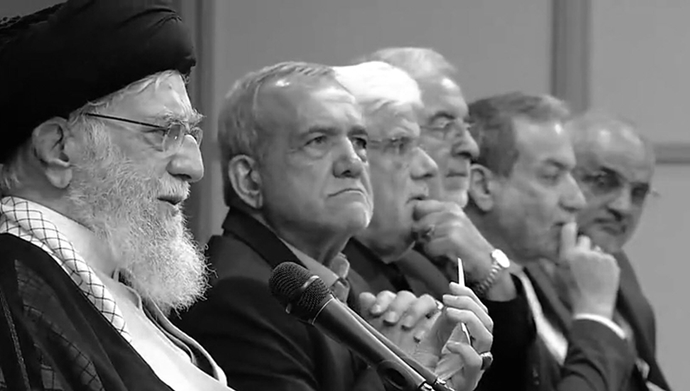
He claims that his administration represents a diverse range of viewpoints, striving to create a government of national unity through factional partnerships and quotas. However, the reality of the situation tells a different story. Despite Pezeshkian’s assertions, the cabinet he introduced is essentially a mix of ministers from previous governments and representatives from various factions of the regime, rather than a genuine representation of all perspectives.
Pezeshkian has placed significant emphasis on the “Seventh Development Plan,” a program initially drafted by the late former president Ebrahim Raisi and approved by Supreme Leader Ali Khamenei. However, despite his efforts to portray a united front, the cracks in his administration are becoming increasingly visible.
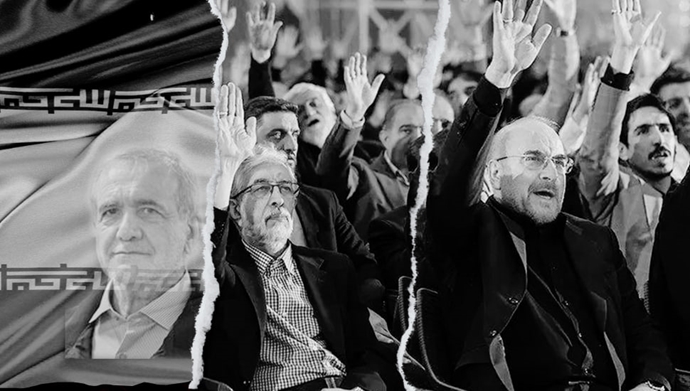
F
ollowing the cabinet’s approval by the Majlis (parliament), what has emerged is not a united government but rather a fragmented administration teetering on the brink of multiple crises. Factional dissatisfaction is rampant, with no group content with its share of power, leading to escalating tensions.
This discontent has been echoed in the country’s Friday sermons, where religious leaders have issued stern warnings to Pezeshkian. Ahmad Alamolhoda, the Friday Prayer leader in Mashhad, advised Pezeshkian to emulate Raisi and avoid straying from the Supreme Leader’s guidance. Similarly, Hosseini Hamadani, the Friday prayer leader in Karaj, reminded Pezeshkian that, following Khamenei’s endorsement, excuses for failure would no longer be tolerated.

Critics argue that Pezeshkian sidelined Zarif before the parliamentary vote only to reinstate him afterward, provoking allegations of dishonesty from both political opponents and media outlets like Kayhan newspaper.
Moreover, reformist allies of Pezeshkian have criticized the cabinet as a continuation of Raisi’s government, deriding it as a quota-based assembly rather than a new, unified administration.
In essence, what Pezeshkian touts as a “cabinet of unity” appears more like a hastily assembled coalition, precariously balanced on the remnants of previous governments, and besieged by internal conflicts and public unrest.