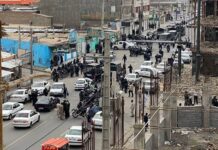
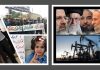
The recent unrest has seen a diverse group of participants, including workers, retirees, farmers, and truck drivers, all demanding a reevaluation of the government’s policies and their rights.
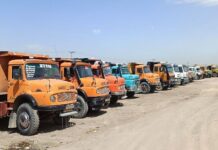
The protests began intensifying over the last few days, reaching a critical point with truck drivers across Tehran, Asaluyeh, and Babayi Expressway striking against drastic cuts to their fuel rations. The decision to reduce these subsidies has come at a time when fuel prices are skyrocketing, significantly impacting the truck drivers’ livelihoods and contributing to a broader increase in living costs.
This series of strikes included a poignant display on Tehran’s Babayi Expressway, where drivers showcased a large placard stating, “In the year of ‘production leap,’ we don’t have diesel fuel.”
April 27—Babayi Expressway (Tehran), #Iran
Truck drivers on strike, protesting the significant reduction of their fuel rations. #IranProtestspic.twitter.com/RQjbf9ImgN— People's Mojahedin Organization of Iran (PMOI/MEK) (@Mojahedineng) April 27, 2024
This slogan references a comment by Iran’s supreme leader, Ali Khamenei, marking the Persian calendar year 1403 as the year of “production leap,” highlighting the irony of the situation. Further south, in Rudbar-e Jonubi, tomato farmers protested against pricing rules that threaten their agricultural output.
In a symbolic gesture of dissent, farmers dumped their crops in front of a government building, signaling their displeasure with the current agricultural policies that fail to protect their interests amid escalating costs.
April 27—Rudbar-e Jonubi, southeast #Iran
Tomato farmers rally in front of the governorate in protest to pricing rules that are negatively affecting their livelihoods.#IranProtests pic.twitter.com/AHGb18e0pF— People's Mojahedin Organization of Iran (PMOI/MEK) (@Mojahedineng) April 27, 2024
The protests also extended to the Iranian Offshore Oil Company workers on Lavan Island, who are demanding improvements in wage policies and working conditions. These workers have faced months of neglect, with their grievances going unheard by the authorities. Similarly, employees of Iran Khodro, a state-backed carmaker, rallied in Tehran demanding the delivery of Pejo Pars cars and a halt to incessant price hikes.
In Shush, the situation escalated as workers from Pars Paper protested against the dismissal of 100 colleagues and the disregard of their calls for better work conditions and fair wages.
April 27—Tehran, #Iran
Customers of Iran Khodro hold protest rally in front of the offices of the National Competition Council as the state-backed carmaker refrains from delivering their Pejo Pars purchases and has instead raised the prices.#IranProtests pic.twitter.com/WfXAEqDiHl— People's Mojahedin Organization of Iran (PMOI/MEK) (@Mojahedineng) April 27, 2024
The workers’ chants, “Shout for your rights workers!” and “Down with the oppressor, hail to the workers!” echoed through the streets, underlining their resolve. The retirees of the Social Security Organization have not been silent either.
With regular rallies, they continue to demand adjustments to their pensions in line with the soaring cost of living a demand the government has persistently ignored. In Ahvaz and Arak, the retirees’ protests also took a poignant turn as they criticized the regime’s prioritization of enforcing hijab laws over addressing economic hardships, chanting, “Let go of the headscarf, tend to our problems!”
April 28—Arak, central #Iran
Retirees and pensioners of the Social Security Organization resume protest rallies to demand higher pensions and other basic needs.
"Let go of the headscarf, tend to our problems," protesters chant#IranProtestspic.twitter.com/pqleAZmRwa— People's Mojahedin Organization of Iran (PMOI/MEK) (@Mojahedineng) April 28, 2024
These protests not only demonstrate widespread dissatisfaction with economic management and social policies but also highlight the regime’s failure to address basic needs while focusing resources on oppressive measures. The ongoing unrest in Iran serves as a stark reminder of the critical state of human rights and economic stability in the country, urging an immediate reassessment of governmental priorities and policies.

MEK Iran (follow us on Twitter and Facebook), Maryam Rajavi’s on her site, Twitter & Facebook, NCRI (Twitter & Facebook), and People’s Mojahedin Organization of Iran – MEK IRAN – YouTu