By Clifford Kupchan, CLIFFORD KUPCHAN is a director at Eurasia Group, a political risk consulting firm.
April 23, 2006
IRAN’S KEY ALLY in the current nuclear crisis is not Russia or China. It’s oil. Tehran can easily drive up prices and is already beginning to do so to rattle the West. As the crisis escalates, Washington’s diplomatic partners will become gravely worried about their energy supplies. In the end, Iran’s petro power will probably trump Western diplomacy.
Just look at what’s happening: Tehran’s bravado announcement April 11 that it had mastered key nuclear technology drew censure from world capitals. But it also drove oil prices to more than $70 a barrel on fears that increasing tensions or future military strikes might disrupt Iranian exports and damage Western economies. Prices have risen more than $8 a barrel in less than three weeks, primarily because of Iran.
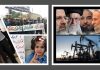
Tehran’s oil leverage is formidable, flowing from its role as the world’s fourth-largest producer of oil and its strategic location abreast the Strait of Hormuz, through which 20% of the world’s production passes. Iran produces 4 million barrels of oil a day, about 5% of world production, and exports 2.5 million barrels. And it has used oil to build a web of relationships that make key countries dependent on its supplies.
Today, Iran supplies China with 4% of its oil, France with 7%, Korea with 9%, Japan with 10%, Italy with 11%, Belgium with 14%, Turkey with 22% and Greece with 24%. Those dependencies will create increasing unease over U.S. attempts to pressure Tehran. If the U.S. continues to seek economic sanctions against Iran in the nuclear crisis — or if it continues to hint at the possibility of military action — Tehran will increasingly use petro power in three ways.



 Telegraph, Apr. 15- President Mahmoud Ahmadinejad of Iran appeared to threaten Israel with a nuclear attack yesterday when he described it as a "rotten, dried tree" that would be annihilated by "one storm". In his most vitriolic and anti-semitic attack to date, Mr Ahmadinejad warned that Israel faced imminent destruction. While he did not refer explicitly to nuclear weapons, his reference to the "one storm" that would do away with Israel was seen as a code for nuclear Armageddon….


 April 24, Stop Fundamentalism –Reuters reported Sunday that Iran said that it would not abandon its work on uranium enrichment as the United States and the Europeans demand. Iran says that it will “face the consequences,†Reuters reported quoting Hamid Reza Asefi, the Foreign Mystery spokesman of Iran.
 (Stop Fundamentalism) – News agencies report that the United States pressed Russia on Friday to halt missile sales to Iran amid international efforts to defuse a standoff with Tehran over its disputed nuclear program.